
Sarcophagi
Classification
architecture
Department
Smithsonian Collection
Museum
Smithsonian American Art Museum
Credit
Museum purchase through gift of various donors and from Eleanor G. Hewitt Fund
Accession Number
1938-88-1395
Rights
Public Domain
About this artwork
Research in Progress
Art Historical Context
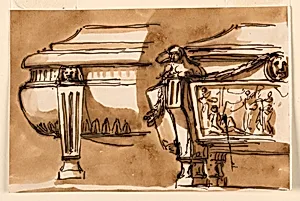
Giuseppe Barberi, a Italian architect and designer (1746–1809), created *Sarcophagi* 1780, during the height of the Neoclassical. This period saw artists and architects drawing inspiration from ancient Roman and Greek antiquity, reviving classical forms to evoke grandeur and permanence. Barberi's work reflects this fascination, likely presenting ornate coffin designs that blend architectural precision with decorative elegance—hallmarks of his Roman practice, where he specialized in ornamental motifs for buildings, furniture, and funerary art. Classified as architecture and housed in the Smithsonian American Art Museum's Smithsonian Collection, *Sarcophagi* exemplifies the era's scholarly pursuit of archaeological accuracy. Sarcophagi, stone coffins often carved with mythological scenes, were rediscovered treasures from imperial Rome, symbolizing eternal legacy. Barberi's interpretation would have appealed to enlightened patrons commissioning memorials that merged utility with artistic splendor. Acquired through museum purchase with gifts from various donors and the Eleanor G. Hewitt Fund, this piece invites visitors to ponder the interplay of life, death, and design in 18th-century Europe. Though research continues, it stands as a window into Neoclassicism's enduring dialogue with the past.