
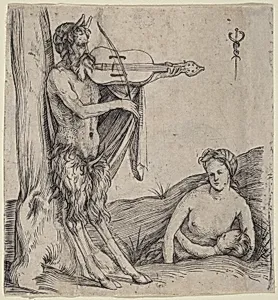
Satyr's Family
c. 1503/1504
Medium
engraving
Dimensions
sheet (trimmed to plate mark): 8.4 x 7.9 cm (3 5/16 x 3 1/8 in.)
Classification
Department
CG-E
Museum
National Gallery of Art, Washington, D.C.
Credit
Rosenwald Collection
Accession Number
1943.3.939
Rights
Public Domain
Art Historical Context
Created around 1503/1504 by the Venetian artist Jacopo de' Barbari, *Satyr's Family* is a delicate engraving measuring just over three inches square. Barbari, who worked across Italy and Northern Europe, was among the first Italian printmakers to achieve international recognition. His engravings often merged the graceful figures of the Italian Renaissance with the precise linework favored by Northern artists, helping to spread new artistic ideas through portable prints. The subject draws on classical mythology, depicting a satyr family in an intimate domestic moment. Such scenes were popular during the Renaissance as artists and collectors rediscovered ancient texts and explored themes of nature, fertility, and the human condition. As an engraving, the work could be reproduced and shared widely, allowing these imaginative subjects to reach audiences beyond palace walls. Housed in the National Gallery of Art’s Rosenwald Collection, this small print exemplifies how Renaissance printmaking transformed art from rare luxury objects into something more accessible while preserving remarkable technical finesse.
About the Artist
Jacopo de' Barbari · 1497–1516
Jacopo de' Barbari (c. 1460/70–before 1516) was an Italian painter, printmaker, and miniaturist of Venetian background whose career unfolded across the courts and workshops of northern Europe, making him one of the most important conduits between Italian Renaissance art and the northern artistic tradition in the years around 1500. Little is known of his training or his early decades; Alvise Vivari...