
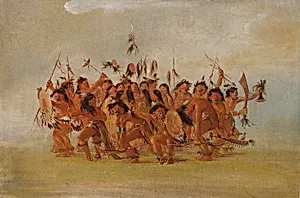
Scalp Dance, Mouth of the Teton River
1835-1837
Medium
Painting
Classification
Painting
Department
Smithsonian Collection
Museum
Smithsonian American Art Museum
Credit
Smithsonian American Art Museum, Gift of Mrs. Joseph Harrison, Jr.
Accession Number
1985.66.438
Rights
Public Domain
Tags
About this artwork
“The Scalp-dance is given as a celebration of a victory; and amongst this tribe [Western Sioux/Lakota], as I learned whilst residing with them, danced in the night, by the light of their torches, and just before retiring to bed. When a war party returns from a war excursion, bringing home with them the scalps of their enemies, they generally ‘dance them’ for fifteen nights in succession, vaunting forth the most extravagant boasts of their wonderful prowess in war, whilst they brandish their war ...
Art Historical Context
George Catlin's *Scalp Dance, Mouth the Teton River*1835–1837) captures a vivid moment in Lakota Sioux (Western Dakota) culture during the early 19th century. Painted in oil, this work depicts a traditional victory celebration where warriors, fresh from battle, danced around torches at night, brandishing weapons and fresh enemy scalps held aloft by young women. Catlin, a pioneering American artist, sketched the scene firsthand near Fort Pierre in 2 while traveling among Plains tribes to document their vanishing ways of life before European influence forever altered them. As a key figure in 19th-century ethnographic art, Catlin's realistic style—rooted in direct observation—brings the raw energy of the ritual to life. He described the dancers' "frantic leaps" and "glaring eye-balls," their yelps echoing like battle cries under flaming flambeaux, emphasizing the ceremony's intensity as a 15-night boast of prowess. This Smithsonian American Art Museum treasure highlights the Lakota's warrior traditions and communal spirit. Today, the painting offers a window into pre-reservation Native American life, underscoring Catlin's urgent mission to preserve these customs through art amid rapid cultural upheaval.
About the Artist
George Catlin · 1796–1872
George Catlin (1796–1872), born in Wilkes-Barre, Pennsylvania, to Putnam Catlin and Polly Sutton—who had been captured by Native Americans during the 1778 Battle of Wyoming—initially pursued a legal career. Trained at Litchfield Law School, he was admitted to the bar in 1819 but abandoned law after two years to study art in Philadelphia in 1823. Self-taught as a portraitist, Catlin quickly gained ...