
Scarab seal
Unknown Artist
ca. 6th century BCE
Medium
Jasper, green
Dimensions
Seal Face: 1.43 x 1.17 cm Height: 0.95 String Hole: 0.25
Classification
Stone-Stamp Seals
Period
Iron Age, Phoenicia (?)
Department
Ancient Near Eastern Art
Museum
Metropolitan Museum of Art, New York, NY
Credit
Bequest of W. Gedney Beatty, 1941
Accession Number
41.160.164
Rights
Public Domain
Art Historical Context
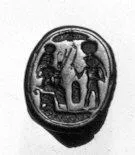
Welcome to the Ancient Near Eastern Art gallery at the Metropolitan Museum of Art where this exquisite *Scarab seal*, dating to around the 6th century, offers a glimpse into Iron Age Phoenicia—or a closely related culture. Crafted from vibrant green jasper, a durable and precious stone prized for its color and hardness, this tiny artifact measures just 1. x 1.17 cm on its seal face, with a height of 0.95 cm and a practical string hole of 0.25 cm. Its beetle-shaped form, typical of scarabs, was ingeniously carved to create impressions when rolled or stamped into clay or wax. These stone-stamp seals were essential tools in the ancient world, functioning like personal signatures for authenticating documents, goods, or ownership during trade and administration. The Phoenicians, renowned seafarers and traders, likely used such seals in their bustling ports, and the engraving of human figures on the base (as suggested by its classification) hints at symbolic motifs—perhaps deities, officials, or daily life scenes—that conveyed identity and authority. The precision required for such minuscule carving showcases masterful lapidary techniques, transforming a humble insect shape into a vessel of cultural power. Bequeathed to the Met in 1941 by W. Gedney Beatty, this scarab invites us to ponder the interconnected Mediterranean world of the Iron Age, where a small green gem bridged commerce, religion, and artistry across ancient civilizations.