
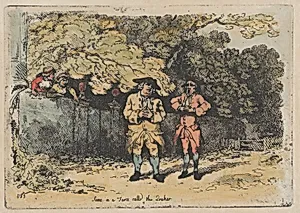
Scene in a Farce called The Quaker
December 22, 1783
Medium
Hand-colored etching
Dimensions
Plate: 7 3/8 × 10 9/16 in. (18.8 × 26.8 cm) Sheet: 9 × 12 in. (22.9 × 30.5 cm)
Classification
Prints
Department
Drawings and Prints
Museum
Metropolitan Museum of Art, New York, NY
Credit
The Elisha Whittelsey Collection, The Elisha Whittelsey Fund, 1959
Accession Number
59.533.1874
Rights
Public Domain
Tags
Art Historical Context
Step into the lively world of 18th London theater with *Scene in a Farce called Quaker*, a hand-colored created by Thomas Rowlandson after a performance on December 22 1783. This satirical print captures performers Charles Dibdin, John Bann, and William Parsons in Isaac Bickerstaff's popular comic farce *The Quaker* (1775), a lighthearted tale of mistaken identities and Quaker simplicity that delighted audiences at venues like the Haymarket Theatre. The work reflects the era's booming theater culture, where farces blended humor, music, and social commentary, often drawing crowds for their witty portrayals of everyday follies. Rowlandson, a master of caricature known for his exaggerated figures and bustling scenes, employed hand-coloring on the etching to bring vibrant energy to the composition. Measuring about 7⅜ × 10⁹⁄₁₆ inches on the plate, the print's delicate lines and bold hues highlight the actors' expressive poses—Bannister as the bumbling Quaker Steady, Parsons in a supporting role—evoking the chaotic charm of live performance. As a print from the Metropolitan Museum of Art's Drawings and Prints department, it exemplifies Georgian satire's role in documenting popular entertainment. This piece offers a vivid snapshot of Britain's theatrical golden age, preserving the star power of Dibdin's musical farces (sometimes tagged with opera due to their songs) and the era's love for men in comedic drag and mishaps. A delightful window into 1780s leisure! (218 words)
About the Artist
Charles Dibdin|John Bannister|William Parsons|Thomas Rowlandson (British|British) · 1745 |1757 –1814 |1827
British, 1745–1814|British, London 1757–1827 London