
Schildering
1700 - 1750
Medium
paper
Dimensions
h 27.2cm × w 33.2cm
Classification
painting, finger painting
Museum
Rijksmuseum, Amsterdam
Rights
Public Domain
About this artwork
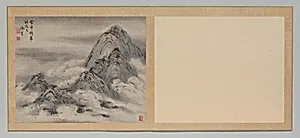
Eén van twaalf landschappen, vingerschildering met opschrift van de schilder Gao Qipei (1662 - 1731(?)). Opmerking: Zie inv. nr. AK-MAK-290.
Art Historical Context
Behold *Schildering*, a landscape finger painting by Gao Qipe (1662–1731?), one of China's innovative Qing dynasty artists. Created between 1700 and 1750 on paper (27.2 × 33.2 cm), this exemplifies Gao's pioneering technique of *zhǐ huà*—painting directly with fingers and fingernails instead of brushes. This method allowed for bold, spontaneous ink strokes that captured the misty essence of nature, blending traditional literati ideals with personal expressiveness. As one of twelve landscapes in the series, each bearing the artist's inscription, *Schildering* reflects the Qing era's reverence for harmonious mountain-and-water scenes (*shanshui*), symbolizing philosophical balance and the scholar's retreat from worldly chaos. Gao's finger painting broke conventions, influencing later artists by emphasizing tactile freedom over rigid brushwork, making his works intimate treasures for collectors. This small-scale gem invites viewers to ponder the artist's touch—literally—evident in its textured washes and dynamic forms, a testament to ingenuity in 18th-century Chinese art. (178 words)
About the Artist
Gao Qipei · 1672–1732
Gao Qipei (1660-1734) was a revolutionary Chinese painter of the Qing Dynasty who is recognized as the founding father of finger painting, a technique that discarded the traditional Chinese brush in favor of using hands, fingers, palms, and nails to create paintings. Born into a Manchu military family of nobility, Gao achieved success both as an imperial official, eventually reaching the rank of v...