
Schildering
1700 - 1750
Medium
paper
Dimensions
h 27.2cm × w 33.2cm
Classification
painting, finger painting
Museum
Rijksmuseum, Amsterdam
Rights
Public Domain
About this artwork
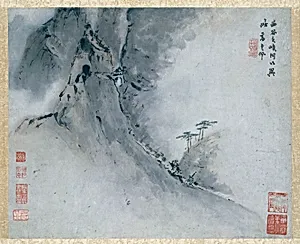
Eén van twaalf landschappen, vingerschildering met opschrift van de schilder Gao Qipei (1662 - 1731(?)). Opmerking: Zie inv. nr. AK-MAK-290.
Art Historical Context
**Schildering by Gaoipei** This delicate landscape painting, titled *Schildering*, is a masterful example of finger painting by Gaoipei (1662–1731?), a innovative artist of China's Qing dynasty. Created between 1700 and 1750 on paper (27.2 × 33.2 cm), it forms part of a rare series of twelve landscapes, each bearing the artist's own inscription. Gao revolutionized traditional ink painting by using his fingers and fingernails instead of brushes, achieving bold, expressive strokes that capture the misty essence of nature with remarkable fluidity and spontaneity. Finger painting, or *shou mo*, was Gao's signature technique, blending scholarly literati traditions with personal flair during a period when Chinese art emphasized harmony between man and the natural world. His works reflect the Qing era's cultural sophistication, where painters like Gao drew from Orthodox school influences while pushing boundaries. This intimate-scale piece invites viewers to appreciate the tactile genius behind its creation—no brush, just the human hand evoking rugged mountains and serene vistas. Housed alongside its series companion (inv. nr. AK-MAK-290), *Schildering* highlights Gao's enduring legacy as a bridge between classical techniques and bold experimentation, offering a window into 18th-century Chinese artistic ingenuity.
About the Artist
Gao Qipei · 1672–1732
Gao Qipei (1660-1734) was a revolutionary Chinese painter of the Qing Dynasty who is recognized as the founding father of finger painting, a technique that discarded the traditional Chinese brush in favor of using hands, fingers, palms, and nails to create paintings. Born into a Manchu military family of nobility, Gao achieved success both as an imperial official, eventually reaching the rank of v...