
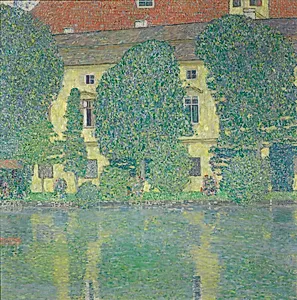
Schloss Kammer am Attersee III
1911/1912
Medium
Öl auf Leinwand
Dimensions
110 × 110 cm
Classification
Gemälde
Department
Belvedere Collection
Museum
Belvedere
Credit
Belvedere, Vienna
Accession Number
4318
Rights
Public Domain
About this artwork
„Wohlbehalten angekommen, Operngucker vergessen – brauche notwendig”, meldet Klimt 1915 aus seinem Feriendomizil am Attersee seiner Schwester Hermine. Wozu der Künstler ausgerechnet während der Sommerfrische optische Hilfsmittel benötigt – neben dem Operngucker auch ein Fernrohr –, macht dieses Bild verständlich: Es zeigt die seeseitige Fassade von Schloss Kammer. Klimt bringt sie wohl vom gegenüberliegenden Ufer aus mithilfe eines Teleskops auf die Leinwand. Durch den Zoomeffekt werden die Bäum...
Art Historical Context
In the summer of 1911 or 1912, Gustavt, the renowned Austrian symbolist and co-founder of the Vienna Sec, captured the serene beauty of Schloss Kammer am Attersee III during his annual retreat to the Attersee lake in Austria's Salzkammergut region. This oil on canvas painting (110 × 110 cm), now in Vienna's Belvedere Collection, Klimt's late-career fascination with landscapes, a departure from his iconic gold-leaf portraits. These summer escapes provided respite from Vienna's urban intensity, allowing him to immerse in nature's patterns and light. Klimt painted the castle's lakeside facade from the opposite shore, employing opera glasses and a telescope for a dramatic zoom effect—as he cheekily noted in a 1915 letter to his sister Hermine about needing such aids during his "Feriendomizil." This technique flattens the composition: foreground trees, the low terrace, and the red-roofed main building merge into a single plane, while the lake's softly blurred reflections integrate seamlessly, evoking a tapestry-like unity. Artistically, the work showcases Klimt's evolving style, blending impressionistic dissolution of forms with a proto-abstract flatness, foreshadowing modernist experiments. Its square format and intricate surface invite viewers to ponder how optical tools transformed a distant vista into an intimate, mosaic vision of harmony between architecture and nature.
About the Artist
Gustav Klimt · 1862–1918
Gustav Klimt was born on July 14, 1862, in Baumgarten near Vienna, the second of seven children in a modest family of artistic bent. His father, Ernst Klimt, a gold engraver who had immigrated from Bohemia, and his mother, Anna Finster, an aspiring musician, instilled an early appreciation for craft and creativity amid financial hardship. Klimt displayed prodigious drawing talent, prompting his en...