
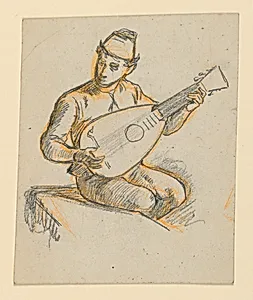
Seated boy playing a lute
Classification
figures
Department
Smithsonian Collection
Museum
Smithsonian American Art Museum
Credit
Gift of the American Academy of Arts and Letters
Accession Number
1955-38-26
Rights
Public Domain
About this artwork
Research in Progress
Art Historical Context
Elihu Vedder, a prominent American artist (1836–1923), created *Seated Boy Playing a Lute* around 1890, capturing a moment of quiet introspection amid the Aesthetic Movement's emphasis on beauty and symbolism. Born in New York but spending much of his career in Italy among expatriate artists, Vedder drew inspiration from Renaissance masters, Pre-Raphaelite ideals, and Eastern motifs. His works often evoke dreamlike, poetic atmospheres, blending realism with mystical undertones—this intimate figure study exemplifies his skill in rendering contemplative human forms. The painting depicts a young boy seated and absorbed in playing a lute, a nod to historical associations with music, melancholy, and artistic reverie in 19th-century Romanticism. Though the medium remains unidentified amid ongoing research, Vedder's technique likely employed his signature soft modeling and rich tonal harmonies to convey emotional depth, inviting viewers to ponder themes of youth, creativity, and timeless harmony. Housed in the Smithsonian American Art Museum as part of the Smithsonian Collection (gift of the American Academy of Arts and Letters), this piece highlights Vedder's enduring influence on American symbolism. It offers visitors a serene portal into late Victorian artistry, where everyday innocence meets profound artistic expression.