
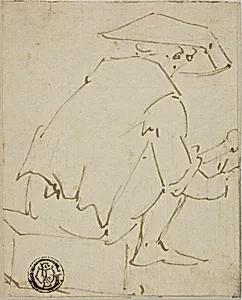
Seated Man Seen from the Back
17th century
Medium
Pen and brown, over traces of graphite, on cream laid paper, laid down on cream laid paper
Dimensions
8.4 × 6.7 cm (3 5/16 × 2 11/16 in.)
Classification
pen and ink drawings
Department
Prints and Drawings
Museum
Art Institute of Chicago
Accession Number
84704
Rights
Public Domain
Art Historical Context
This intimate drawing, *Seated Man Seen from Back*, captures a solitary figure in a simple, contemplative pose, rendered by an unknown artist in the th century. Measuring just 8.4 × 6.7 cm, its diminutive scale suggests it was likely a quick sketch from life or imagination, executed on cream laid paper—a favored support for draftsmen of the era due to its smooth texture and availability. The work belongs to the Art Institute of Chicago's Prints Drawings collection, where such modest gems offer glimpses into the daily practice of Baroque-age artists. The technique reveals masterful economy: faint graphite traces outline the form, providing a subtle underdrawing for proportions, over which bold pen lines in brown ink define the contours, folds of clothing, and posture with fluid precision. Brown ink, derived from iron gall or oak galls, was a staple in 17th-century European workshops, prized for its durability and rich tonal range. This layered approach highlights the preparatory nature of many period drawings, often studies for larger paintings or sculptures amid the era's focus on naturalism and human anatomy. Though anonymous, the piece embodies the artistic culture of the 1600s, when sketchbooks brimmed with such figure studies, influencing masters like Rembrandt or the Carracci. Its preservation—laid down on secondary paper for protection—underscores its enduring value, inviting us to ponder the everyday genius behind grand masterpieces.