
Seated Man with Extended Left Arm
n.d.
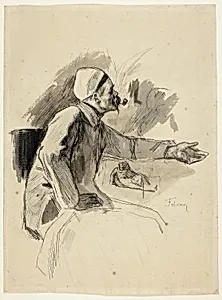
Medium
Pen and black ink, with brush and gray wash and black crayon, over graphite, on cream laid paper
Dimensions
32.7 × 24.3 cm (12 7/8 × 9 5/8 in.)
Classification
pen and ink drawings
Department
Prints and Drawings
Museum
Art Institute of Chicago
Accession Number
55203
Rights
Public Domain
Art Historical Context
Félicien Rops' *Seated Man with Extended Left Arm* (n.d.) captures a moment of poised tension in a masterful mixed-media drawing on cream laid paper. Measuring 32.7 × 24.3 cm, this work from the Art Institute of Chicago's Prints and Drawings department showcases the Belgian artist's deft hand through pen and black ink lines, enhanced by brush and gray wash for subtle shading, black crayon for bold accents, and an underlying graphite sketch. The seated figure's outstretched left arm draws the eye, suggesting a study in anatomy and gesture that reveals Rops' fascination with the human form. Rops (1833–1898), a pivotal figure in 19th-century Symbolism and the Decadent movement, was renowned for his intricate, often provocative illustrations and prints. His style blended precise draughtsmanship with dramatic contrasts, reflecting the era's interest in psychological depth and eroticism. Here, the layered techniques—graphite for initial outlines, ink for definition, wash for volume, and crayon for emphasis—demonstrate how 19th-century artists on paper achieved sculptural realism without sculpture's permanence. This undated drawing exemplifies Rops' experimental approach to mixed media, prized for its immediacy and tactile quality. Visitors can appreciate how such works bridged fine art and commercial illustration, offering a window into the artist's studio process during Belgium's vibrant fin-de-siècle scene.
About the Artist
Félicien Rops · 1833–1898
Félicien Rops, born Félicien Victor Joseph Rops on July 7, 1833, in Namur, Belgium, to a prosperous textile manufacturing family, displayed prodigious artistic talent from youth. The only child of Nicholas Rops and Sophie Maubile, he received private tutoring until age ten, followed by education at a Jesuit school in Namur (1843–1848), the Athénée Royal de Namur, and the Academy of Fine Arts there...