
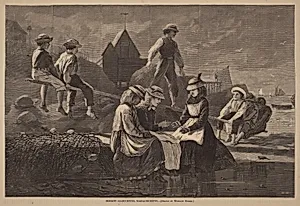
Seesaw - Gloucester, Massachusetts
published 1874
Medium
wood engraving
Classification
Department
CG-W
Museum
National Gallery of Art, Washington, D.C.
Credit
Gift of Addie Burr Clark
Accession Number
1946.9.89
Rights
Public Domain
Art Historical Context
"Seesaw - Gloucester, Massachusetts" is a charming wood engraving published in 1874, created after the designs of Winslow Homer, one of America's foremost realist artists. Homer, renowned for his vivid depictions of everyday American life, coastal scenes, and the sea, captured the simple joys of childhood in this playful image. Set in the bustling fishing port of Gloucester, Massachusetts—a place Homer frequented for inspiration—the print likely shows children gleefully balancing on a seesaw, evoking a sense of carefree leisure amid the town's rugged maritime backdrop. Wood engraving, the medium here, was a pivotal 19th-century technique for mass reproduction. Artists like Homer drew originals that engravers meticulously carved into end-grain wood blocks, allowing for fine details and high-quality prints in periodicals such as *Harper's Weekly*. This method democratized art, bringing Homer's masterful compositions to a wide audience during the post-Civil War era, when illustrations shaped public views of national identity and recreation. Generously gifted to the National Gallery of Art by Addie Burr Clark, this print exemplifies Homer's enduring influence on American visual culture. It reminds us how a momentary snapshot of play could symbolize resilience and innocence in a changing nation. (198 words)
About the Artist
after Winslow Homer
"After Winslow Homer" is the conventional attribution in art historical catalogs for a body of mid- to late-19th-century wood engravings that reproduce the illustrations drawn by the eminent American realist painter Winslow Homer (1836–1910) for popular periodicals, most notably Harper's Weekly. Beginning in 1857, shortly after Harper's Weekly launched in New York, Homer contributed hundreds of sk...