
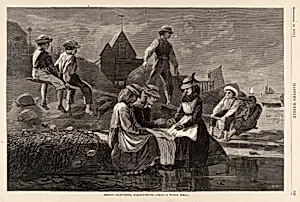
Seesaw--Gloucester, Massachusetts, from Harper's Weekly, September 12, 1874
1874
Medium
Graphic Arts-Print
Classification
Graphic Arts-Print
Department
Smithsonian Collection
Museum
Smithsonian American Art Museum
Credit
Smithsonian American Art Museum, The Ray Austrian Collection, gift of Beatrice L. Austrian, Caryl A. Austrian and James A. Austrian
Accession Number
1996.63.100
Rights
Public Domain
Tags
Art Historical Context
Winslow Homer's *Seesaw—Gloucester, Massachusetts*, in *Harper's Weekly* on 12, 1874, captures a joyful moment of childhood play along the rugged New England coast. This graphic arts print depicts children gleefully balancing on makeshift seesaw, their simple wooden apparatus set against the backdrop of Gloucester's fishing village. Homer, a master of American Realism, excelled at portraying everyday life with vivid authenticity, and this wood engraving—likely based on his on-site sketches—brings the scene to life through dynamic lines and subtle shading that convey motion and exuberance. As a prominent illustrator for *Harper's Weekly*, one of America's leading 19th-century magazines, Homer reached vast audiences with his detailed reportage. His time in Gloucester, a bustling port town, inspired many works reflecting post-Civil War optimism and the resilience of coastal communities. The print's classification as a graphic arts piece highlights the era's innovative printmaking techniques, where wood engravings allowed for mass reproduction of high-quality images, democratizing art. Today, housed in the Smithsonian American Art Museum as part of The Ray Austrian Collection, this charming scene reminds us of timeless childhood innocence amid industrial change. Homer's keen eye for human connection makes it a delightful window into 1870s America. (198 words)
About the Artist
Winslow Homer · 1836–1910
Winslow Homer (1836-1910) was one of America's greatest painters and a preeminent figure in 19th-century American art. Largely self-taught, Homer began his career as a commercial illustrator and Civil War correspondent for Harper's Weekly before becoming renowned for his powerful marine subjects and landscape paintings. His mastery of both oil and watercolor, combined with his uncompromising reali...