
Seite 133
1898
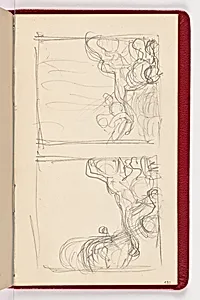
Medium
In rotes Leder gebundenes Büchlein, Zeichnungen und Notizen mit Bleistift und ein Schwarzweiß-Foto
Dimensions
Skizzenbuch: 14,3 × 9,2 × 1,4 cm
Classification
Skizzenbuch
Department
Belvedere Collection
Museum
Belvedere
Credit
Belvedere, Vienna
Accession Number
8508/135
Rights
Public Domain
About this artwork
Weitere Varianten bewegter Formen.
Art Historical Context
**Seite 133 from Gustav Klimt's Sketch (1898)** Nestled within a compact red leather-bound sketchbook14.3 × 9.2 × 1.4 cm), *Seite 133* offers an intimate glimpse into the creative mind of Gustav Klimt, pioneering Austrian artist and co-founder of the Vienna Sec movement. Dated 1898, this page features pencil drawings, handwritten notes, and a black-and-white photograph—hallmarks of Klimt's meticulous preparatory process during a transformative period. The Belvedere Collection in Vienna treasures this artifact as a rare window into his studio practice, where he broke from academic traditions to embrace ornamental, symbolic forms inspired by Art Nouveau. The page's notation, "Weitere Varianten bewegter Formen" ("Further variants of moving forms"), reveals Klimt's fascination with dynamic, fluid shapes—echoing the swirling motifs that would define his iconic works like *The Kiss* and the Beethoven Frieze. These pencil sketches capture rapid explorations of motion and rhythm, blending observation with imagination, while the inserted photo adds a modern, documentary touch rare for the era. Sketchbooks like this were Klimt's private laboratories, essential for refining the sensual, gilded style that revolutionized fin-de-siècle art. For visitors, *Seite 133* humanizes a master: beneath the opulent surfaces of his paintings lay these humble, energetic studies, underscoring his commitment to innovation and the organic flow of life itself. (198 words)
About the Artist
Gustav Klimt · 1862–1918
Gustav Klimt was born on July 14, 1862, in Baumgarten near Vienna, the second of seven children in a modest family of artistic bent. His father, Ernst Klimt, a gold engraver who had immigrated from Bohemia, and his mother, Anna Finster, an aspiring musician, instilled an early appreciation for craft and creativity amid financial hardship. Klimt displayed prodigious drawing talent, prompting his en...