
Seite 97
1898
Medium
In rotes Leder gebundenes Büchlein, Zeichnungen und Notizen mit Bleistift und ein Schwarzweiß-Foto
Dimensions
Skizzenbuch: 14,3 × 9,2 × 1,4 cm
Classification
Skizzenbuch
Department
Belvedere Collection
Museum
Belvedere
Credit
Belvedere, Vienna
Accession Number
8508/99
Rights
Public Domain
About this artwork
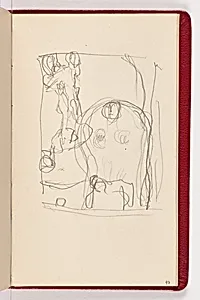
Die Figur des/der gramgebeugten Alten wieder weiter links als in Seite 91 und stärker nach vorne geneigt.
Art Historical Context
**Page 97 from Gustav Klimt's Sketch (1898)** led within a compact red leather-bound sketchbook14.3 × 9.2 × 1.4 cm), *Seite 97* Gustav Klimt's masterful pencil sketches and notes, by a black-and-white. Created in 1898, this intimate page captures the artist's exploratory process during a pivotal moment in his career. Klimt, a leading figure in Vienna's Secessionist movement and Art Nouveau, often filled such personal notebooks with preparatory studies that bridged his symbolic, decorative style with raw human observation. The focal point is a poignant figure of a hunched elderly person, positioned further left than on the preceding *Seite 91* and bent even more dramatically forward. This iterative refinement highlights Klimt's technique of anatomical precision and emotional depth, likely exploring themes of age, vulnerability, and mortality—recurring motifs in his oeuvre, from *The Kiss* to his later portraits. Such sketches reveal the groundwork for his iconic gold-leaf paintings, blending realism with stylized ornamentation. Housed in Vienna's Belvedere Collection, this sketchbook page offers a rare glimpse into Klimt's private genius, underscoring the Secession's push against academic rigidity. For visitors, it's a testament to how fleeting pencil strokes birthed enduring masterpieces, inviting reflection on the beauty in human frailty.
About the Artist
Gustav Klimt · 1862–1918
Gustav Klimt was born on July 14, 1862, in Baumgarten near Vienna, the second of seven children in a modest family of artistic bent. His father, Ernst Klimt, a gold engraver who had immigrated from Bohemia, and his mother, Anna Finster, an aspiring musician, instilled an early appreciation for craft and creativity amid financial hardship. Klimt displayed prodigious drawing talent, prompting his en...