
Self-Portrait III
1926
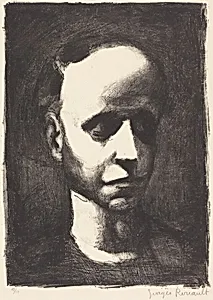
Medium
lithograph
Classification
Department
CG-W
Museum
National Gallery of Art, Washington, D.C.
Credit
Rosenwald Collection
Accession Number
1943.3.7541
Rights
Public Domain
Art Historical Context
Georges Rouault's *Self-Portrait III*1926) is a striking lithograph that captures the French artist's introspective gaze during the interwar years. Born in 1871, Rouault apprenticed under stained-glass makers and studied with Gustave Moreau, influences that shaped his distinctive Expressionist style—marked by bold black contours, vivid colors, and a raw emotional intensity evoking medieval religious art. This self-portrait, part of a series, reveals Rouault's weathered features and piercing eyes, reflecting personal struggles amid Europe's turbulent 1920s. As a lithograph, the work exemplifies early 20th-century printmaking, where grease crayon on stone allowed for rich tonal variations and multiple editions, making elite art more accessible. Rouault's technique mimics the glow of stained glass, with heavy outlines enclosing luminous hues, blending autobiography and spirituality. Housed in the National Gallery of Art's Rosenwald Collection (Department CG-W), it underscores the donor's passion for masterful prints. This piece invites visitors to ponder Rouault's humanity—his blend of faith, critique of modernity, and unflinching self-examination—offering a window into an artist's soul.
About the Artist
Georges Rouault · 1871–1958
Georges-Henri Rouault was born on May 27, 1871, in a Paris cellar during the violent "Bloody Week" of the Paris Commune, when a stray shell destroyed his family's home in the working-class Belleville district. Raised by a carpenter father who worked at the Pleyel piano factory and a grandfather who collected prints by Honoré Daumier, Rembrandt, Courbet, and Manet, Rouault showed early artistic pro...