
Self-Portrait in the Studio (Selbstbildnis im Atelier)
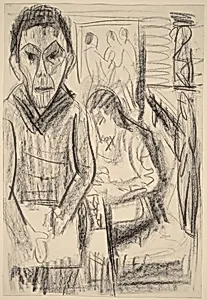
Medium
black crayon on board
Dimensions
sheet: 49.8 × 33.9 cm (19 5/8 × 13 3/8 in.)
Classification
Drawing
Department
CG-W
Museum
National Gallery of Art, Washington, D.C.
Credit
Gift of Ruth Cole Kainen
Accession Number
2012.92.751
Rights
Public Domain
Art Historical Context
Ernst Ludwig Kirchner, a pioneering figure in German Expressionism and co-founder of the Die Br group, created *Self-Portrait in the Studio* in 1923. This intimate captures the artist in his creative sanctuary during a turbulent period. By the early 1920s, Kirchner had to Davos, Switzerland, seeking respite from the psychological scars of World War I and personal struggles. His self-portraits from this era often reveal a raw introspection, blending vulnerability with defiant creativity amid the Weimar Republic's cultural ferment. Rendered in bold black crayon on board (49.8 × 33.9 cm), the work exemplifies Kirchner's mastery of line and form. The medium's directness allows for sweeping, angular strokes that convey emotional intensity—a hallmark of Expressionism—distilling complex inner states into stark contrasts of light and shadow. Unlike his earlier vibrant woodcuts, this later drawing reflects a more subdued palette, emphasizing psychological depth over color. Now housed in the National Gallery of Art as a gift from Ruth Cole Kainen, this piece invites visitors to ponder the artist's resilient spirit. It underscores how Kirchner's studio became both refuge and battleground, offering a poignant glimpse into the human cost of modernism.
About the Artist
Ernst Ludwig Kirchner · 1880–1938
Ernst Ludwig Kirchner was born on May 6, 1880, in Aschaffenburg, Germany, to parents Ernst and Maria Kirchner, part of a family of Prussian descent that frequently relocated due to his father's career as a chemical technician. After early schooling in various towns, he studied architecture at the Königliche Technische Hochschule (Technical University) in Dresden from 1901 to 1905, taking courses i...