
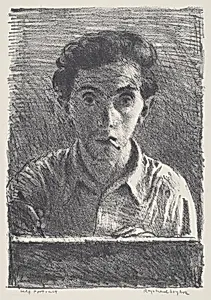
Self-Portrait
c. 1920
Medium
lithograph in black on paper
Dimensions
image: 22.23 × 15.88 cm (8 3/4 × 6 1/4 in.)
Classification
Department
CG-W
Museum
National Gallery of Art, Washington, D.C.
Credit
Rosenwald Collection
Accession Number
1943.3.7982
Rights
Public Domain
Art Historical Context
Raphael Soyer's *Self-Portrait* (c. 1920) is a striking lithograph that captures the artist in his early twenties, rendered in crisp black ink on paper. Measuring just 8¾ × 6¼ inches, this intimate print exemplifies Soyer's lifelong commitment to realism, a style he honed after immigrating from Russia to the United States as a child. Created during the post-World War I era, when America buzzed with jazz-age optimism yet simmered with social undercurrents, the work reflects Soyer's emerging voice as a chronicler of human experience. As a master printmaker, Soyer employed lithography—a planographic technique using greasy crayon on stone or metal—to achieve fine lines and subtle tones that convey introspection and vulnerability. This self-portrait foreshadows his later Social Realist masterpieces, which depicted urban laborers and immigrants with unflinching empathy during the Great Depression. Housed in the National Gallery of Art's Rosenwald Collection, a treasure trove of prints gifted by collector Lessing J. Rosenwald, it highlights the medium's accessibility, allowing artists like Soyer to reach wider audiences beyond oil paintings. Visitors will appreciate how this modest yet powerful image invites personal connection, embodying Soyer's belief in art's role to humanize the everyday. A timeless glimpse into the artist's soul at the dawn of his career.