
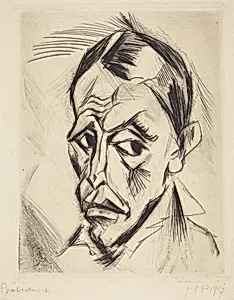
Self-Portrait
1917
Medium
drypoint and roulette on wove paper
Dimensions
plate: 17.9 x 14 cm (7 1/16 x 5 1/2 in.) sheet: 24 x 20 cm (9 7/16 x 7 7/8 in.)
Classification
Department
CG-W
Museum
National Gallery of Art, Washington, D.C.
Credit
Rosenwald Collection
Accession Number
1951.10.377
Rights
Public Domain
Art Historical Context
Max Pechstein’s 1917 *Self-Portrait* captures the introspective intensity of German Expressionism during the First World War. A leading member of the influential Die Brücke group, Pechstein used the human face as a vehicle for raw emotion rather than literal likeness. The spare, angular lines of this print convey both personal vulnerability and the broader anxieties of a turbulent era. The work is executed in drypoint and roulette, techniques that allow the artist to scratch directly into the copper plate. Drypoint’s characteristic burr produces velvety, irregular lines, while the roulette wheel adds textured passages that heighten the print’s tactile quality. Printed on wove paper, the small plate size invites close viewing, emphasizing the intimate dialogue between artist and viewer. Acquired for the Rosenwald Collection at the National Gallery of Art, this print exemplifies how Expressionist artists turned to graphic media to reach wider audiences with emotionally charged imagery. Its modest dimensions and direct technique underscore Pechstein’s commitment to expressive immediacy over polished finish.
About the Artist
Max Pechstein · 1881–1955
Hermann Max Pechstein (1881–1955) was born in Zwickau, Germany, the son of a craftsman in the textile industry. He trained as a decorative painter in his home city before enrolling at the School of Applied Arts in Dresden and then transferring to the Royal Academy of Fine Arts, where he studied under the painter Otto Gussmann. His early exposure to the work of Vincent van Gogh proved decisive in d...