
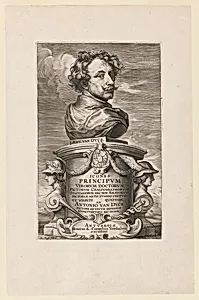
Self-Portrait of Anthony van Dyck
Classification
Department
Smithsonian Collection
Museum
Smithsonian American Art Museum
Credit
Gift of Milton Einstein
Accession Number
1959-49-11
Rights
Public Domain
About this artwork
Research in Progress
Art Historical Context
Anthony van Dyck (1599–1641), a Netherlandish painter of the Baroque era, was renowned for his elegant portraits that captured the nobility and grace of his sitters. A protégé of Peter Paul Rubens, van Dyck rose to prominence as principal court painter to King Charles I of England, where his fluid brushwork, luminous colors, and psychological insight defined the grandeur of 17th-century portraiture This *Self-Portrait*, preserved as a print dated 1720 in the American Art Museum's collection, likely reproduces one of van Dyck's introspective self-images from his lifetime, showcasing his characteristic poise and refined self-presentation. As a print—medium details under ongoing research—this work highlights the enduring legacy of van Dyck's art nearly eight decades after his death. Prints like this one democratized access to masterpieces, allowing admirers across Europe to own affordable facsimiles of celebrated paintings. Donated by Milton Einstein to the Smithsonian Collection, it exemplifies how 18th-century engraving techniques preserved and popularized Baroque icons, bridging van Dyck's innovative style with later artistic traditions. Van Dyck's self-portraits offer rare glimpses into the artist's persona amid his meteoric career, blending vanity with vulnerability. Though research continues, this piece invites visitors to ponder his influence on portraiture, from Reynolds to modern photographers. (198 words)