
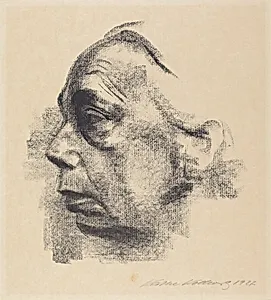
Self-Portrait (Selbstbildnis)
1927
Medium
lithograph
Dimensions
sheet: 64.5 x 45 cm (25 3/8 x 17 11/16 in.)
Classification
Department
CG-W
Museum
National Gallery of Art, Washington, D.C.
Credit
Gift of Mr. and Mrs. Edward R. Gray
Accession Number
1985.19.1
Rights
Public Domain
Art Historical Context
Käthe Kollwitz'sSelf-Portrait (Selbildnis)* of 1927 is a lithograph that captures the German artist's unflinching gaze at age 60. Born in 1867, Kollwitz rose to prominence as a leading figure in Expressionism, a movement emphasizing raw emotion and social realism over idealized beauty. Her works often depicted the hardships of the working class, war's toll, and women's struggles—themes drawn from her own life amid Germany's turbulent Weimar Republic era, marked by economic strife and political unrest. This self-portrait exemplifies her lifelong fascination with introspection, presenting a series of evolving visages that trace her physical and emotional journey. Printed on a generous sheet measuring 64.5 x 45 cm, the lithograph showcases Kollwitz's mastery of the medium. Lithography, a planographic process using grease crayon on limestone, allowed her to achieve rich tonal contrasts and expressive lines, making prints accessible and reproducible for broader audiences—a democratic impulse central to her ethos. Now housed in the National Gallery of Art as a gift from Mr. and Mrs. Edward R. Gray, this work invites viewers to confront aging and resilience, much like Kollwitz's broader oeuvre, which earned her international acclaim and a place among 20th-century printmaking giants.
About the Artist
Käthe Kollwitz · 1867–1945
Käthe Kollwitz (1867–1945) was a German artist whose powerful images of poverty, war, and maternal grief established her as the foremost practitioner of socially engaged art in early 20th-century Europe. Working primarily in printmaking—including etching, lithography, and woodcut—as well as drawing and sculpture, Kollwitz created works of raw emotional power that gave voice to the suffering of wor...