
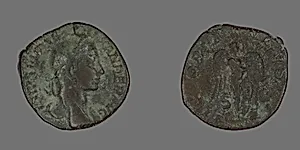
Sestertius (Coin) Portraying Emperor Severus Alexander
Medium
Bronze
Dimensions
Diam.: 3.1 cm (1 1/4 in.)
Classification
coin
Department
Arts of Greece, Rome, and Byzantium
Museum
Art Institute of Chicago
Accession Number
141744
Rights
Public Domain
Art Historical Context
This bronze sestertius, struck in 230 CE, features a portrait of Emperor Severus Alexander, youthful ruler of Rome from 222 to 235 CE and the last of the Sever dynasty. Measuring just 3.1 cm in diameter, this coin was a substantial denomination in the Roman economy, used for everyday transactions while serving as imperial propaganda. The obverse likely bears the emperor's laureate bust, a common motif symbolizing victory and divine favor, while the reverse might depict deities like Jupiter or allegorical figures promoting stability amid the empire's growing crises. As a prime example of Roman numismatic art, the sestertius showcases masterful die-engraving techniques, where intricate details—such as Severus Alexander's curly hair, draped armor, and imperial regalia—were hammered into blanks under high pressure for mass production. These coins, part of the vast output from Roman mints, circulated empire-wide, making the emperor's image familiar to soldiers, merchants, and citizens alike. Housed in the Art Institute of Chicago's Arts of Greece, Rome, and Byzantium department, this artifact highlights how Roman coinage blended artistry, politics, and economics, immortalizing a leader whose reign bridged the Pax Romana's decline and foreshadowed the empire's turbulent third century. A small object with outsized influence!
About the Artist
Ancient Roman
The artists attributed to "Ancient Roman" in museum collections represent the anonymous craftsmen who produced the vast output of sculpture, frescoes, mosaics, and reliefs defining Roman visual culture from the Republic (c. 509–27 BCE) to the late Empire (c. 395 CE). Individual identities remain elusive, as Roman makers were typically viewed as skilled tradesmen—often enslaved Greeks or provincial...