
Sestertius (Coin) Portraying Philip the Arab
Medium
Bronze
Dimensions
Diam.: 3 cm (1 3/16 in.)
Classification
coin
Department
Arts of Greece, Rome, and Byzantium
Museum
Art Institute of Chicago
Accession Number
141786
Rights
Public Domain
About this artwork
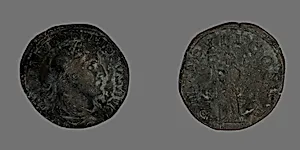
The front (obverse) of this coin portrays emperor Philip I, better known as Philip the Arab thanks to his birthplace of Aurantis, Arabia (modern day Syria), facing right and wearing a crown of laurels. On the back (reverse) the personification of Gladness is depicted standing, facing left and holding a long caduceus and a horn.
Art Historical Context
This bronze sestertius, struck in 246 CE during the reign of Emperor Philip the Arab, captures the ruler's stern profile on its obverse, a hallmark of Roman imperial coinage. Measuring just 3 cm in diameter, coins were everyday currency yet served as powerful tools of propaganda, disseminating the emperor's image across the vast Roman Empire. Philip, born in Arabia and ruling from 244 to 249 CE, was the first Roman emperor of Arab origin, bridging Eastern influences with Roman tradition amid a turbulent era of military campaigns and economic strain. As a large-denomination bronze coin, the sestertius exemplified Roman minting techniques: finely engraved dies hammered onto heated metal flans to create raised relief portraits and inscriptions. The reverse likely featured symbolic motifs like deities or victories, reinforcing imperial legitimacy. Housed in the Art Institute of Chicago's Arts of Greece, Rome, and Byzantium department, this artifact illuminates daily Roman life, from commerce to political messaging, offering a tangible link to the empire's millennial celebrations approaching in 248 CE. (178 words)
About the Artist
Ancient Roman
The artists attributed to "Ancient Roman" in museum collections represent the anonymous craftsmen who produced the vast output of sculpture, frescoes, mosaics, and reliefs defining Roman visual culture from the Republic (c. 509–27 BCE) to the late Empire (c. 395 CE). Individual identities remain elusive, as Roman makers were typically viewed as skilled tradesmen—often enslaved Greeks or provincial...