
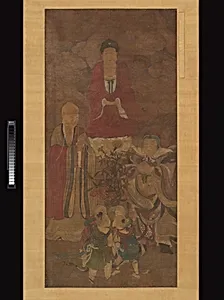
明 佚名 禮佛圖 軸|Shakyamuni with luohan, heavenly king, and boys
early 17th century
Medium
Hanging scroll; ink and color on silk
Dimensions
Image: 41 1/2 x 19 1/2 in. (105.4 x 49.5 cm) Overall with mounting: 105 1/2 x 26 in. (268 x 66 cm) Overall with knobs: 105 1/2 x 31 in. (268 x 78.7 cm)
Classification
Paintings
Culture & Period
China · Ming dynasty (1368–1644)
Department
Asian Art
Museum
Metropolitan Museum of Art, New York, NY
Credit
John Stewart Kennedy Fund, 1913
Accession Number
13.220.12
Rights
Public Domain
Tags
Art Historical Context
This exquisite hanging scroll, titled *Shakyamuni with Luohan, Heavenly King, and Boys* (禮佛圖軸), hails from the early 17th century during China's Ming dynasty (1368–1644). Created by an unidentified artist, it measures an impressive 41½ x 19½ inches in its image area, rendered in ink and color on silk—a medium prized for its luminous quality and suitability for intimate, meditative viewing. The composition captures a devotional scene central to Chinese Buddhism: Shakyamuni Buddha at the center, flanked by a luohan (enlightened disciple), a protective heavenly king, and attendant boys, evoking reverence and harmony. Hanging scrolls like this were cherished in scholarly and temple settings, unrolled for contemplation during rituals or private reflection. The Ming era saw a revival of Buddhist art amid cultural patronage, blending meticulous ink outlines with vibrant mineral pigments to convey spiritual depth and lifelike presence. The inclusion of youthful boys highlights themes of devotion across generations, underscoring Buddhism's enduring role in Ming society as a source of moral guidance and cosmic order. Acquired through the John Stewart Kennedy Fund in 1913, this work exemplifies the Metropolitan Museum of Art's rich Asian collection, offering visitors a window into the refined aesthetics and pious spirit of imperial China.