
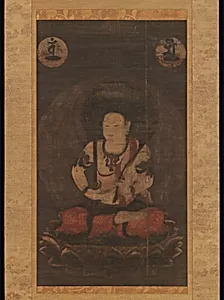
五髻文殊菩薩像|The Bodhisattva Monju (Manjushri) with Five Topknots
Unknown Artist
13th century
Medium
Hanging scroll; ink and color on silk
Dimensions
Image: 36 3/4 × 20 3/4 in. (93.3 × 52.7 cm) Overall with mounting: 79 3/4 × 29 1/2 in. (202.6 × 74.9 cm) Overall with knobs: 31 1/2 in. (80 cm)
Classification
Paintings
Culture & Period
Japan · Kamakura period (1185–1333)
Department
Asian Art
Museum
Metropolitan Museum of Art, New York, NY
Credit
H. O. Havemeyer Collection, Bequest of Mrs. H. O. Havemeyer, 1929
Accession Number
29.100.466
Rights
Public Domain
Tags
Art Historical Context
This exquisite hanging scroll depicts the Bodhisattva Manjushri (Monju in Japanese), revered in Buddhism as the embodiment of transcendent wisdom. Here, he is portrayed in his rare "Five Topknots" form五髻文殊菩薩—adorned with five chignons crowning his head, a distinctive iconographic feature symbolizing profound enlightenment and esoteric knowledge. Created by an unknown artist in 13th-century Japan during the Kamakura (1185–1333), the work measures 36 3/4 × 20 3/4 inches in its image area, rendered in delicate ink and color on silk, a medium prized for its luminous quality and suitability for ritual display. The Kamakura era marked a transformative time in Japanese art, blending aristocratic elegance with emerging realism influenced by Zen and Esoteric Buddhism. Hanging scrolls like this were unrolled for meditation, ceremonies, or private devotion, allowing viewers to immerse themselves in the sacred image. Manjushri, often shown wielding a sword to sever ignorance, underscores Buddhism's emphasis on intellectual clarity amid the period's social upheavals, including samurai rule and spiritual fervor. Part of the Metropolitan Museum of Art's Asian Art collection, gifted through the H. O. Havemeyer bequest in 1929, this scroll exemplifies Kamakura painting's refined techniques—crisp ink lines, vibrant mineral pigments, and gold accents—that brought divine figures vividly to life, inviting contemplation of wisdom's timeless power.