
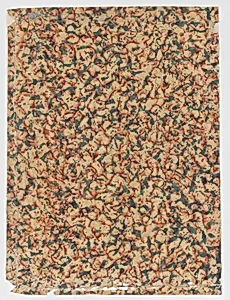
Sheet with overall splotchy pattern
19th century
Medium
Relief print (wood or metal)
Dimensions
Sheet: 11 1/16 × 8 1/4 in. (28.1 × 21 cm)
Classification
Prints
Department
Drawings and Prints
Museum
Metropolitan Museum of Art, New York, NY
Credit
Harris Brisbane Dick Fund, 1939
Accession Number
39.13.297
Rights
Public Domain
Art Historical Context
Welcome to the Metropolitan Museum of Art's Drawings and Prints department, where we encounter this intriguing *Sheet with overall splot pattern*, an anonymous relief print from the 19th. Measuring 11 1/16 × 8 1/4 inches (28.1 × 21 cm), this modest sheet features a textured, mottled design created through the raised surfaces of a wood or metal block inked and pressed onto paper. Relief printing, one of the oldest printmaking techniques, was widely used in the 1800s for everything from book illustrations to decorative papers, allowing for efficient reproduction of patterns. In the context of 19th-century industry, such prints often served practical purposes—like samples for wallpapers, textiles, or bookbinding—reflecting the era's explosion in mass-produced ornamentation amid the Industrial Revolution. The splotchy, organic pattern evokes a sense of whimsy and texture, possibly mimicking natural effects like marbleizing or stippling, techniques popular for adding visual depth without complex machinery. Acquired through the Harris Brisbane Dick Fund in 1939, this piece highlights the Met's commitment to preserving everyday artistic output. Though anonymous, it whispers of the skilled, unnamed artisans whose innovations shaped modern design, inviting us to appreciate the beauty in utilitarian craft.
About the Artist
Anonymous
In the vast tapestry of art history, "Anonymous" stands not as a singular individual but as a collective designation for countless unidentified creators whose works have endured across millennia. These artists, spanning prehistoric cave painters to medieval illuminators and folk craftsmen, produced the foundational layers of human visual culture. Prior to the Renaissance, when individual fame emer...