
Shimadai, or Island-stand for Wedding Arrangement
19th century
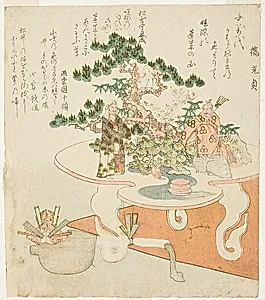
Medium
Color woodblock print; surimono
Dimensions
22 × 20.1 cm (8 11/16 × 7 15/16 in.)
Classification
woodblock print
Department
Arts of Asia
Museum
Art Institute of Chicago
Accession Number
81610
Rights
Public Domain
Art Historical Context
Totoya Hokkei's *Shimadai, or-stand for Wedding Arrangement is a delightful 19th-century color woodblock print from Japan's Edo period, exemplifying the intimate art of *surimono*. These privately commissioned prints, often produced for New Year's greetings or poetry gatherings, were luxurious confections made with fine papers, metallic pigments, and embossing for a tactile richness. Hokkei, a pupil of the famed Katsushika Hokusai, brought his master's precision to this compact 22 × 20.1 cm work, capturing the ephemeral beauty of everyday customs with vibrant colors and intricate details. At its heart, the print depicts a *shimadai*, a tiered "island stand" central to traditional Japanese weddings. Adorned with seasonal flowers, fruits, and symbolic gifts, it served as a ceremonial display wishing the couple prosperity and harmony. Hokkei's composition highlights the stand's ornate layers, evoking the joy of matrimonial rituals amid the ukiyo-e ("floating world") tradition that celebrated life's pleasures. Housed in the Art Institute of Chicago's Arts of Asia collection, this surimono offers a window into elite Edo culture, where art intertwined with poetry and social bonds. Its small scale belies its cultural depth, reminding us how woodblock printing democratized beauty while preserving cherished customs.
About the Artist
Totoya Hokkei · 1780–1850
Totoya Hokkei (魚屋 北渓, 1780–1850), born Iwakubo Tatsuyuki in Edo (modern Tokyo), began his life as a humble fishmonger in the Yotsuya Samegahashi district, a trade reflected in his art name "Totoya," meaning fish shop. He transitioned to art through rigorous training, first studying under Kanō Yōsen'in Korenobu, head of the Kobikichō branch of the prestigious Kanō school, where he honed landscape p...