
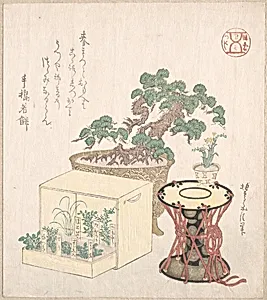
Potted Pine Tree Drum and Seven Herbs Planted in a Box
18th–19th century
Medium
Woodblock print (surimono); ink and color on paper
Dimensions
8 3/8 x 7 5/16 in. (21.3 x 18.6 cm)
Classification
Prints
Culture
Japan
Department
Asian Art
Museum
Metropolitan Museum of Art, New York, NY
Credit
H. O. Havemeyer Collection, Bequest of Mrs. H. O. Havemeyer, 1929
Accession Number
JP2199
Rights
Public Domain
Tags
Art Historical Context
Welcome to the Metropolitan Museum of Art's Asian Art collection, where you'll find *Potted Pine Tree Drum and Seven Planted in a Box a delicate woodblock print (surono) by Sunayamaosei from the 18th–19th century. This intimate work, measuring just 8 3/8 x 7 5/16 inches, exemplifies surimono—privately commissioned prints popular among Japan's literati during the Edo period. Unlike mass-produced ukiyo-e, surimono were luxurious New Year's greetings, often pairing poetry with vivid imagery using ink and color on paper, sometimes enhanced with mica or embossing for a shimmering effect. The composition captures symbolic still-life elements: a potted pine tree, evoking longevity and resilience as an evergreen emblem in Japanese culture; a drum, perhaps nodding to festive rhythms; and a box of seven herbs, likely referencing *nanakusa no sekku*—the January 7th Festival of Seven Herbs. This tradition celebrates renewal and health with spring greens like shepherd's purse and chickweed, warding off evil and promoting vitality. Sunayama Gosei, a specialist in such refined prints, masterfully balances these motifs in a compact format, blending naturalism with auspicious meaning. Part of the esteemed H. O. Havemeyer Collection, this piece highlights Japan's poetic printmaking tradition, inviting viewers to ponder seasonal harmony and cultural rituals in everyday elegance.