
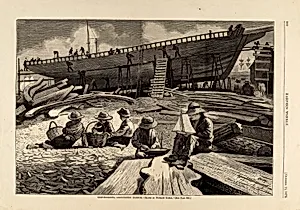
Ship-building, Gloucester Harbor, from Harper's Weekly, October 11, 1873
1873
Medium
Graphic Arts-Print
Classification
Graphic Arts-Print
Department
Smithsonian Collection
Museum
Smithsonian American Art Museum
Credit
Smithsonian American Art Museum, The Ray Austrian Collection, gift of Beatrice L. Austrian, Caryl A. Austrian and James A. Austrian
Accession Number
1996.63.88
Rights
Public Domain
Tags
Art Historical Context
Winslow Homer's *Ship-building, Gloucester Harbor published in *Harper's Weekly* on 11, 1873, captures the bustling energy of New England maritime life during America's post-Civil War industrial boom. As a renowned Realist artist, Homer began his career as a wood engraving correspondent for the popular magazine, documenting everyday scenes with vivid detail and authenticity. This print depicts shipbuilding activity in Gloucester Harbor, Massachusetts—a vital hub for fishing and ship construction—highlighting the labor of workers and the presence of children, who often learned trades in such communities. Rendered as a graphic arts print, likely a wood engraving, the work showcases Homer's mastery of black-and-white contrast to convey texture, movement, and depth. The medium was revolutionary for its time, allowing high-quality images to reach a mass audience via weekly periodicals, democratizing art and journalism. Homer's precise lines evoke the creak of timber, the salt air, and the rhythm of communal effort, reflecting the era's economic reliance on seafaring industries. Housed in the Smithsonian American Art Museum as part of The Ray Austrian Collection, this piece exemplifies Homer's early style before his shift to iconic oil paintings of the sea. It invites visitors to ponder the unsung heroes of America's coastal heritage, blending historical documentation with timeless artistic appeal.
About the Artist
Winslow Homer · 1836–1910
Winslow Homer (1836-1910) was one of America's greatest painters and a preeminent figure in 19th-century American art. Largely self-taught, Homer began his career as a commercial illustrator and Civil War correspondent for Harper's Weekly before becoming renowned for his powerful marine subjects and landscape paintings. His mastery of both oil and watercolor, combined with his uncompromising reali...