
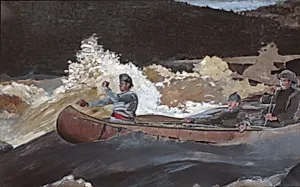
Shooting the Rapids, Saguenay River
1905–10
Medium
Oil on canvas with chalk
Dimensions
30 x 48 1/4 in. (76.2 x 122.6 cm) Framed: 39 7/8 x 58 x 3 1/2 in. (101.3 x 147.3 x 8.9 cm)
Classification
Painting
Culture
American
Department
The American Wing
Museum
Metropolitan Museum of Art, New York, NY
Credit
Gift of Charles S. Homer, 1911
Accession Number
11.57
Rights
Public Domain
Tags
Art Historical Context
In the late masterpiece *Shooting the Rapids,aguenay River* (1905–10), American realist Winslow Homer captures the raw thrill of adventure on Quebec's turbulent Saguenay River. when Homer was in his late sixties, the large-scale oil on canvas (30 48¼ inches) depicts sturdy men navigating perilous rapids in wooden boats, their faces tense with determination amid crashing waves and jagged rocks. This scene reflects Homer's lifelong fascination with humanity's precarious dance with nature, a theme honed through decades of coastal and wilderness subjects. Homer, a pioneer of American Realism, masterfully conveys motion and danger through dynamic composition and luminous effects, likely enhanced by chalk underpainting that adds texture and immediacy to the water's foam. Created during his retreats to remote Canadian waters, the work embodies early 20th-century romanticism for untamed landscapes, evoking the era's growing interest in outdoor exploration and rugged individualism. A gift to the Metropolitan Museum of Art from Homer's son Charles S. in 1911, this painting now graces The American Wing, inviting visitors to feel the spray and hear the roar of the rapids—a testament to Homer's enduring power to make nature's drama palpable.
About the Artist
Winslow Homer · 1836–1910
Winslow Homer (1836-1910) was one of America's greatest painters and a preeminent figure in 19th-century American art. Largely self-taught, Homer began his career as a commercial illustrator and Civil War correspondent for Harper's Weekly before becoming renowned for his powerful marine subjects and landscape paintings. His mastery of both oil and watercolor, combined with his uncompromising reali...