
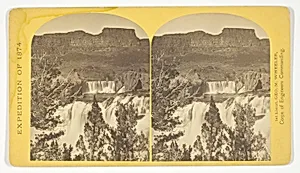
Shoshone Falls, Snake River, Idaho, looking through the timber, and showing the main fall, and upper or "Lace Falls", No. 49 from the series "Geographical Explorations and Surveys West of the 100th Meridian"
Medium
Albumen print, stereo
Dimensions
Each image: 9.2 × 7.5 cm (3 5/8 × 3 in.); Card: 10 × 17.7 cm (3 15/16 × 7 in.)
Classification
stereograph (albumen)
Department
Photography and Media
Museum
Art Institute of Chicago
Accession Number
210786
Rights
Public Domain
About this artwork
In 1871 Timothy O’Sullivan, who had gained acclaim photographing the Civil War, was recruited by George M. Wheeler of the U.S. War Department to join a government survey of lands west of the 100th meridian. Working alongside scientists and cartographers, O’Sullivan produced large-format prints for study and official use, as well as stereographic cards for a general audience. Stereographs were made by taking two photographs of the same scene with lenses about two and a half inches apart to match ...
Art Historical Context
Timothy O’Sullivan created this striking stereograph in1874 while working for the U.S. Army’s Wheeler Survey, one of several government expeditions charting the American West. The image captures Shoshone Falls on Idaho’s Snake River, revealing both the powerful main cascade and the delicate upper “Lace Falls” framed by timber. As part of the series “Geographical Explorations and Surveys West of the 100th Meridian,” the photograph helped document remote landscapes for scientific, military, and settlement purposes, bringing distant wonders to Eastern audiences. Produced as an albumen-print stereograph, the work was designed to be viewed through a stereoscope, creating a vivid three-dimensional effect that heightened the sense of depth and scale. Each small image measures just over three inches, yet together they convey the immense power of the falls. O’Sullivan’s careful composition—looking through the trees—adds a sense of discovery, inviting viewers to feel they are stepping into the wilderness. Today this print in the Art Institute of Chicago’s collection reminds us how photography served both art and exploration in the nineteenth century, preserving a moment when the West was still being mapped and celebrated for its natural grandeur.
About the Artist
Timothy O'Sullivan · 1840–1882
Timothy H. O'Sullivan (c. 1840–1882) emerged as one of America's pioneering photographers during a transformative era. His early life remains sparsely documented, with records suggesting he was born either in New York City or Ireland before immigrating young, possibly growing up on Staten Island. As a teenager, he apprenticed under Mathew Brady at his Fulton Street gallery in New York, mastering w...