
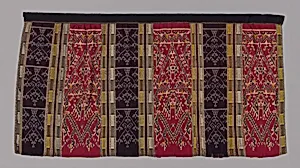
Sin Mi (Woman's Funerary Skirt)
Late 19th century
Medium
Silk and cotton, plain weave with supplementary patterning wefts; resist dyed; edged with cotton and silk, plain weave
Dimensions
148.6 × 79 cm (58 1/2 × 31 1/8 in.); Warp repeat: H.: 48.9 cm (19 1/4 in.)
Classification
textile
Department
Textiles
Museum
Art Institute of Chicago
Accession Number
149006
Rights
Public Domain
Art Historical Context
Welcome to the Textiles gallery, where we encounter the striking *Sin Mi (Woman'serary Skirt)*, crafted by the T'aiua people of northern Laos in the late 19th century This ceremonial garment, measuring 148.6 × 79 cm, was reserved for women's funerals, embodying deep spiritual and communal significance in T'ai Neua culture.oven from silk and cotton, it reflects the region's rich tradition of handcrafted textiles, which served not only practical purposes but also as markers of identity, status, and ritual life. The skirt showcases masterful techniques: a plain weave base enhanced by supplementary patterning wefts that create intricate motifs, repeating every 48.9 cm along the warp. Resist dyeing—likely ikat-style, where threads are tied and dyed before weaving—produces bold, geometric designs in vibrant hues, while cotton and silk edging adds durability and elegance. These methods highlight the T'ai Neua weavers' skill, passed down through generations of women, blending functionality with symbolic artistry. In T'ai Neua society, such skirts were more than fabric; they connected the living with ancestors during mourning rites, their patterns possibly invoking protection or fertility. Today, at the Art Institute of Chicago, this *Sin Mi* invites us to appreciate the enduring cultural legacy of Southeast Asian textile traditions.