
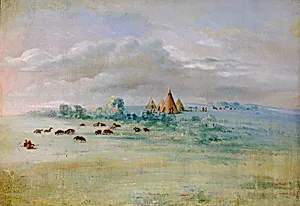
Sioux Village, Lake Calhoun, near Fort Snelling
1835-1836
Medium
Painting
Classification
Painting
Department
Smithsonian Collection
Museum
Smithsonian American Art Museum
Credit
Smithsonian American Art Museum, Gift of Mrs. Joseph Harrison, Jr.
Accession Number
1985.66.335
Rights
Public Domain
Tags
About this artwork
“At this place, on the point of land between the Mississippi and the St. Peters rivers, the United States' Government have erected a strong Fort, which has taken the name of Fort Snelling, from the name of a distinguished and most excellent officer of that name, who superintended the building of it. The site of this Fort is one of the most judicious that could have been selected in the country, both for health and defence; and being on an elevation of 100 feet or more above the water, has an exc...
Art Historical Context
**Sioux Village, Lake Calhoun, near Fort Snelling *George Catlin, 1835-1836, Painting* *Smithsonian American Art Museum, of Mrs. Joseph Harrison Jr.* George Catlin, a pioneering 19th-century American artist, created this evocative painting during or shortly after his 1835 visit to Snelling in present-day Minnesota. Renowned for his romantic portrayals of Native American life and Western landscapes, Catlin sought to document indigenous cultures before they were transformed by American expansion. The scene depicts a Sioux village at Lake Calhoun, featuring teepees, buffalo, and figure groups against the strategic backdrop of the fort, perched high above the Mississippi and St. Peters (Minnesota) rivers. Fort Snelling, named for its builder Colonel Josiah Snelling, was a U.S. military outpost designed for health, defense, and peacekeeping among the Sioux and Chippewa peoples while safeguarding frontier settlers. Catlin's detailed description praises its "bold and picturesque effect," highlighting the tension between natural beauty and encroaching settlement. Likely sketched on-site, the work reflects Catlin's oil painting technique, emphasizing vivid colors and dramatic compositions to immerse viewers in a vanishing world. This artwork holds cultural significance as a primary visual record of Sioux daily life in the 1830s, blending ethnographic observation with artistic passion. It invites us to reflect on the fragile harmony between Native communities and frontier forts, preserving a pivotal moment in American history. (198 words)
About the Artist
George Catlin · 1796–1872
George Catlin (1796–1872), born in Wilkes-Barre, Pennsylvania, to Putnam Catlin and Polly Sutton—who had been captured by Native Americans during the 1778 Battle of Wyoming—initially pursued a legal career. Trained at Litchfield Law School, he was admitted to the bar in 1819 but abandoned law after two years to study art in Philadelphia in 1823. Self-taught as a portraitist, Catlin quickly gained ...