
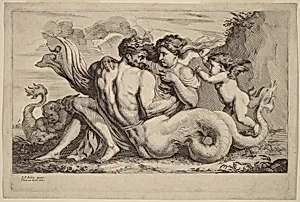
Siren and Triton
1601 to 1650
Medium
engraving on laid paper
Dimensions
plate: 20.6 x 31.8 cm (8 1/8 x 12 1/2 in.) sheet: 22.4 x 33.4 cm (8 13/16 x 13 1/8 in.)
Classification
Department
CG-E
Museum
National Gallery of Art, Washington, D.C.
Credit
Ailsa Mellon Bruce Fund
Accession Number
1996.113.12
Rights
Public Domain
Art Historical Context
Behold the enchanting *Siren and Triton an exquisite engraving by Theodor van Kessel, faithfully reproducing a design by the Baroque master Sir Peter Paul Rubens. Created between 1601 and1650, this print laid paper measures a plate of 20.6 x 31.8 cm, capturing the dramatic energy of Rubens' mythological world. Housed in the National Gallery of Art's Prints department through the Ailsa Mellon Fund, it exemplifies the Flemish artist's flair for dynamic compositions filled with swirling forms and sensual figures. Rubens, a towering figure of the Baroque era, drew inspiration from classical antiquity, blending it with his signature exuberance to depict sea deities like the alluring siren—half-woman, half-fish—and the muscular triton, son of Poseidon. Van Kessel's skilled engraving translates Rubens' oil painting into a reproducible format, making high art accessible to collectors across Europe. This technique involved meticulously incising a copper plate with burins to create fine lines, inked and pressed onto laid paper, whose visible chain lines authenticate its 17th-century origins. As a cultural artifact, *Siren and Triton* reflects the era's fascination with mythology's seductive perils, symbolizing temptation and the untamed sea. Prints like this fueled the booming market for Rubens' imagery, bridging elite patronage and popular devotion to the arts. A true gem for any visitor!