
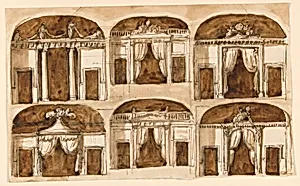
Six Designs for Alcove Elevations
Classification
interiors
Department
Smithsonian Collection
Museum
Smithsonian American Art Museum
Credit
Museum purchase through gift of various donors and from Eleanor G. Hewitt Fund
Accession Number
1938-88-1601
Rights
Public Domain
About this artwork
Research in Progress
Art Historical Context
Giuseppe Barberi, a Italian architect and designer (1746–1809), created *Six Designs for Alcove Elevations* around 1790, showcasing his mastery of neoclassical interior architecture. These drawings depict elegant recessed alcoves—intimate architectural niches often used in grand palaces and villas for displaying art, seating, or private retreats. Barberi, based in Rome, drew inspiration from ancient Roman motifs, blending symmetry, classical columns, and refined ornamentation in a style that bridged the opulent Rococo era with the emerging purity of Neoclassicism. In the late 18th century, as Europe revived antiquity amid Enlightenment ideals, such designs symbolized sophistication and cultural refinement for the aristocracy. Barberi's work reflects this shift, emphasizing proportion and subtle decoration over excess, influencing furnishings and room layouts across Italy and beyond. Though the medium remains unidentified—likely ink, wash, or gouache on paper, common for period elevations—these sketches highlight his role in shaping residential interiors. Now in the Smithsonian American Art Museum's collection (purchased through donor gifts and the Eleanor G. Hewitt Fund), these designs offer a window into 1790s Roman taste, where architecture met artistry in harmonious spaces. Research continues to uncover more about their patrons and execution, inviting us to appreciate Barberi's enduring legacy in decorative arts.