
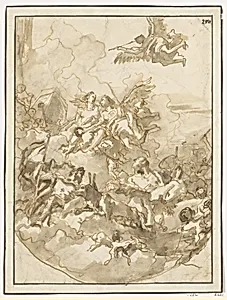
Sketch for a Ceiling with an Allegory of Fortitude and Wisdom
1780–85
Medium
Pen and brown ink, brown wash, over black chalk
Dimensions
10 1/16 x 7 7/16 in. (25.5 x 18.9 cm)
Classification
Drawings
Department
Robert Lehman Collection
Museum
Metropolitan Museum of Art, New York, NY
Credit
Robert Lehman Collection, 1975
Accession Number
1975.1.482
Rights
Public Domain
Art Historical Context
Giovanni Domenico Tiepolo the gifted son of the renowned Venetian Rococo master Giovanni Battista Tiepolo created this delicate *Sketch for a Ceiling with an Allegory of Fort and Wisdom* around 1780–85. Working in pen and brown ink with brown over black chalk on a modest sheet measuring just 10 1/16 x 7 7/16 inches, Tiepolo captured the dynamic energy of ceiling decorations popular in grand European palaces and villas. This preparatory drawing hints at the swirling figures andistic perspectives that defined Rococo frescoes, where like Fortitude (strength and Wisdom were personified to inspire moral elevation. As a late-career work from Tiepolo's time in Venice after his family's Spanish sojourn, it reflects the waning Rococo style amid rising Neoclassicism, blending exuberant ornamentation with symbolic depth. The layered technique—black chalk for underdrawing, ink for precise lines, and wash for atmospheric shading—allowed rapid exploration of compositions meant for expansive ceilings. Housed in the Metropolitan Museum of Art's Robert Lehman Collection since 1975, this sketch offers a rare glimpse into the creative process behind opulent 18th-century interiors, reminding us how artists like Tiepolo turned abstract ideals into breathtaking visual poetry.
About the Artist
Giovanni Domenico Tiepolo · 1727–1804
Giovanni Domenico Tiepolo (1727-1804) was a Venetian painter, printmaker, and draftsman whose career spanned the twilight of the Rococo era. Born on August 30, 1727, in Venice as the eldest son of the celebrated Giovanni Battista Tiepolo, he worked both in his father's shadow and as a significant independent artist who developed a distinctly earthbound and humanistic vision. Domenico's importance...