
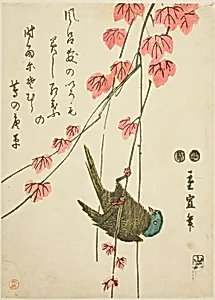
Small bird and ivy
c. 1843/47
Medium
Color woodblock print; koban
Dimensions
21.9 × 15.7 cm (8 5/8 × 6 1/4 in.)
Classification
woodblock print
Department
Arts of Asia
Museum
Art Institute of Chicago
Accession Number
56215
Rights
Public Domain
Art Historical Context
This delicate color woodblock print, titled *Small bird and ivy*, captures a moment of quiet natural beauty from Japan’s late Edo period. Created around 1843–47 by Utagawa Hiroshige II (also known as Shigenobu), it belongs to the ukiyo-e tradition of “pictures of the floating world.” As the adopted son and artistic heir of the celebrated Hiroshige I, the younger artist continued the master’s sensitive approach to landscape and kacho-e (bird-and-flower) subjects, rendering the tiny bird and curling ivy leaves with graceful lines and soft, layered colors. Measuring just 21.9 × 15.7 cm, the work is a koban, a compact format often used for intimate, affordable prints that could be enjoyed in private settings or collected in albums. The woodblock medium itself was revolutionary for its time: skilled artisans carved intricate designs into multiple blocks, allowing precise registration of colors and fine details that brought everyday nature scenes vividly to life for a broad audience. Beyond its visual charm, the print reflects the period’s deep appreciation for seasonal change and the transient beauty of the natural world—ivy symbolizing endurance while the small bird evokes fleeting movement. Today it offers visitors a window into nineteenth-century Japanese aesthetics and the enduring appeal of ukiyo-e craftsmanship preserved in collections like the Art Institute of Chicago.
About the Artist
Utagawa Hiroshige II (Shigenobu) · 1826–1869
Utagawa Hiroshige II, born Suzuki Chinpei in 1826, was one of the most accomplished ukiyo-e artists of mid-nineteenth century Japan. He entered the studio of the celebrated landscape master Utagawa Hiroshige I — known for his iconic series "The Fifty-three Stations of the Tokaido" — and proved himself the most talented of the elder artist's few students. So highly regarded was the young pupil that...