
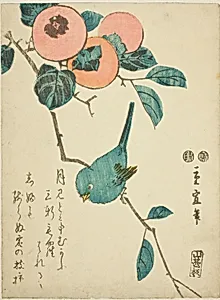
Japanese white-eye and persimmons
c. 1847/52
Medium
Color woodblock print; koban
Dimensions
22.2 × 16.5 cm (8 3/4 × 6 1/2 in.)
Classification
woodblock print
Department
Arts of Asia
Museum
Art Institute of Chicago
Accession Number
56223
Rights
Public Domain
Art Historical Context
This charming color woodblock print, *Japanese White-eye and Persimmons*, was created around 1847–52 by Utagawa Hiroshige II (also known as Shigenobu), a talented pupil and adopted son of the renowned landscape master Utagawa Hiroshige I. Belonging to the ukiyo-e tradition—"pictures of the floating world"—it captures a delicate moment in nature: a small Japanese white-eye bird perched amid vibrant persimmons, evoking the fleeting beauty of autumn. The intimate *koban* format (22.2 × 16.5 cm) made it ideal for personal albums or fans, reflecting the era's booming market for affordable, mass-produced art during Japan's Edo period. Hiroshige II's work exemplifies the precision of woodblock printing, where artisans carved separate blocks for each color, layering inks to achieve subtle gradients and luminous effects. His style blends his mentor's poetic naturalism with intricate details in birds-and-flowers (*kacho-e*) motifs, celebrating seasonal harmony—a core theme in Japanese aesthetics symbolizing impermanence (*mono no aware*). Persimmons, a staple autumn fruit, add cultural resonance, often linked to prosperity and the harvest. Housed in the Art Institute of Chicago's Arts of Asia department, this print offers a window into 19th-century Japan's artistic ingenuity, bridging everyday beauty with profound tranquility for modern viewers.
About the Artist
Utagawa Hiroshige II (Shigenobu) · 1826–1869
Utagawa Hiroshige II, born Suzuki Chinpei in 1826, was one of the most accomplished ukiyo-e artists of mid-nineteenth century Japan. He entered the studio of the celebrated landscape master Utagawa Hiroshige I — known for his iconic series "The Fifty-three Stations of the Tokaido" — and proved himself the most talented of the elder artist's few students. So highly regarded was the young pupil that...