
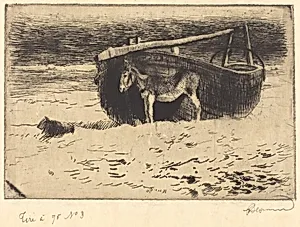
Small Donkey at Berck (Un petit ane à Berck)
1897
Medium
etching and drypoint on wove paper
Dimensions
plate: 11.5 × 17.1 cm (4 1/2 × 6 3/4 in.) sheet: 27.4 × 34.5 cm (10 13/16 × 13 9/16 in.)
Classification
Department
CG-E
Museum
National Gallery of Art, Washington, D.C.
Credit
Rosenwald Collection
Accession Number
1943.3.1477
Rights
Public Domain
Art Historical Context
In the late 19th century, artist Albert Besnard, renowned for his murals, portraits, and innovative prints, turned his gaze to everyday coastal life in *Small Donkey at Ber (Un petit âne à Berck)*, created in 1897. This delicate etching captures a humble scene—a petite donkey in the seaside town of Berck-Mer—evoking the leisurely charm of fin-de-siècle France, artists often sought inspiration in rural and beachside simplicity. Besnard's mastery shines through his combined techniques of etching and drypoint on smooth wove paper. Etching involves incising lines into a metal plate with acid for precise, fluid contours, while drypoint adds direct scratches that raise a soft burr, yielding rich, velvety textures ideal for intimate subjects. At just 11.5 × 17.1 cm (plate size), the work's modest scale draws viewers close, rewarding scrutiny with atmospheric depth and subtle tonal gradations. Housed in the National Gallery of Art's Rosenwald Collection (Department CG-E), this print exemplifies the era's revival of printmaking as a democratic art form, bridging fine art and accessibility. Besnard's piece invites us to pause and appreciate the quiet poetry in ordinary moments.
About the Artist
Albert Besnard · 1849–1934
Paul-Albert Besnard, known as Albert Besnard, was born on June 2, 1849, in Paris to an artistic family: his father, Louis Adolphe Ferdinand Besnard, was a history painter and pupil of Ingres, while his mother, Marie Louise Pauline Vaillant, was a noted miniaturist trained under Lizinska de Mirbel. Precociously talented, he began his training under Jean-François Brémond before entering the École de...