
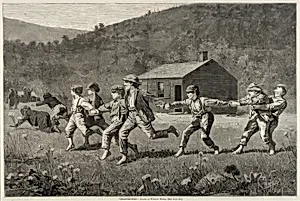
Snap the Whip
1873
Medium
Graphic Arts-Print
Classification
Graphic Arts-Print
Department
Smithsonian Collection
Museum
Smithsonian American Art Museum
Credit
Smithsonian American Art Museum, Museum purchase
Accession Number
1967.66.2
Rights
Public Domain
Tags
Art Historical Context
Winslow Homer's *Snap the Whip* (1873), a vibrant graphic arts print from the Smithsonian American Art Museum's collection, captures a joyful moment of childhood exuberance in rural America. The scene depicts a group of boys gleefully playing the energetic game "snap the whip," linking arms and swinging in a whirlwind on a grassy plain near a modest house. Homer, a master of American Realism, drew from his keen observations of everyday life, infusing the work with dynamic motion and unfiltered authenticity. Created shortly after the Civil War, this print reflects a nostalgic view of post-war innocence and simplicity, evoking the untroubled freedoms of youth amid America's rebuilding landscape. Homer's style—marked by bold lines, earthy tones, and a focus on natural light—translates powerfully into printmaking, making the medium ideal for disseminating his vision to a wider audience through affordable reproductions. As a cultural touchstone, *Snap the Whip* celebrates the timeless rituals of play, reminding viewers of childhood's universal delight. Acquired through museum purchase, it stands as a testament to Homer's enduring influence on American art, blending historical insight with heartwarming nostalgia.
About the Artist
Winslow Homer · 1836–1910
Winslow Homer (1836-1910) was one of America's greatest painters and a preeminent figure in 19th-century American art. Largely self-taught, Homer began his career as a commercial illustrator and Civil War correspondent for Harper's Weekly before becoming renowned for his powerful marine subjects and landscape paintings. His mastery of both oil and watercolor, combined with his uncompromising reali...