
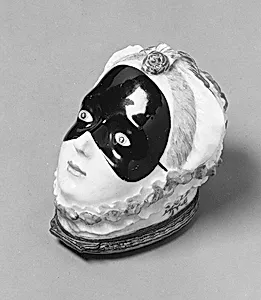
Snuffbox
ca. 1760
Medium
Soft-paste porcelain, enamel, gilt
Dimensions
Length: 3 in. (7.6 cm)
Classification
Ceramics-Porcelain
Culture
British, Chelsea
Department
European Sculpture and Decorative Arts
Museum
Metropolitan Museum of Art, New York, NY
Credit
The Jack and Belle Linsky Collection, 1982
Accession Number
1982.60.343
Rights
Public Domain
Tags
Art Historical Context
This exquisite snuffbox from the Chelsea Porcelain Manufactory dating to around 1760, exemplifies golden age of English soft-paste porcelain. Produced the factory's prestigious "gold anchor" period (1759–1770), it measures just 3 inches long, perfectly sized for the aristocratic ritual of snuff-taking—a fashionable vice among 18th-century Europe's elite. Chelsea, one of Britain's earliest porcelain makers founded in 1743, rivaled Meissen and Sèvres by blending French Rococo whimsy with technical innovation. Crafted from soft-paste porcelain—a glassy, English-developed formula that mimicked rare Chinese hard-paste—the box is vibrantly decorated with enamel paints and gleaming gilding. Its surface likely features playful motifs of masks and heads, evoking theatrical comedy and tragedy or satirical caricatures, common in Chelsea's repertoire of small luxury objects. These intricate techniques required skilled hand-painting and firing, showcasing the manufactory's mastery under director Nicholas Sprimont. Housed in The Metropolitan Museum of Art's European Sculpture and Decorative Arts Department as part of The Jack and Belle Linsky Collection, this snuffbox highlights Britain's burgeoning porcelain industry and the era's love for opulent, portable elegance. A tiny treasure that once nestled in a gentleman's pocket, it whispers of Enlightenment leisure and artistic ambition.
About the Artist
Chelsea Porcelain Manufactory · 1744–1784
**Chelsea Porcelain Manufactory** The Chelsea Porcelain Manufactory, Britain's pioneering porcelain enterprise, was founded around 1743 in Chelsea, London, by two Huguenot silversmiths: Nicholas Sprimont from Liège and Charles Gouyn. Sprimont, trained in Paris as a goldsmith before immigrating to England, brought his expertise in luxury metalwork to the venture, while Gouyn handled early sales th...