
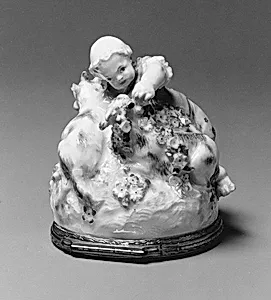
Snuffbox
ca. 1755–60
Medium
Soft-paste porcelain, hardstone, gilt
Dimensions
Height: 2 7/8 in. (7.3 cm)
Classification
Ceramics-Porcelain
Culture
British, Chelsea
Department
European Sculpture and Decorative Arts
Museum
Metropolitan Museum of Art, New York, NY
Credit
The Jack and Belle Linsky Collection, 1982
Accession Number
1982.60.358
Rights
Public Domain
Tags
Art Historical Context
This exquisite snuffbox from the Chelsea Porcelain Manufactory dating to around 1755–60, exemplifies the height of British porcelain artistry during the mid-18th century.ed during Chelsea's prestigious "gold anchor" period it measures just 2 7/8 inches tall, making it a perfect pocket luxury for the aristocracy. Snuffboxes like this held finely ground tobacco snuff, a fashionable vice among Europe's elite, often serving as status symbols adorned with whimsical scenes. Made of soft-paste porcelain—a European innovation blending clay, glass frit, and soapstone to mimic China's prized hard-paste porcelain—the box features intricate gilding and hardstone accents for a lavish finish. Chelsea's soft-paste technique allowed for delicate modeling and vibrant enameling, capturing playful motifs of animals and children that evoke Rococo whimsy and domestic charm. These lively vignettes highlight the factory's mastery in miniature figure painting, rivaling continental rivals like Meissen. Housed in The Metropolitan Museum of Art's Jack and Belle Linsky Collection, this piece reflects Britain's growing porcelain industry amid Enlightenment tastes for refined, nature-inspired ornament. A testament to Chelsea's brief but brilliant legacy (1743–ca. 1770), it invites visitors to appreciate the fusion of utility, opulence, and artistry in everyday elegance.
About the Artist
Chelsea Porcelain Manufactory · 1744–1784
**Chelsea Porcelain Manufactory** The Chelsea Porcelain Manufactory, Britain's pioneering porcelain enterprise, was founded around 1743 in Chelsea, London, by two Huguenot silversmiths: Nicholas Sprimont from Liège and Charles Gouyn. Sprimont, trained in Paris as a goldsmith before immigrating to England, brought his expertise in luxury metalwork to the venture, while Gouyn handled early sales th...