
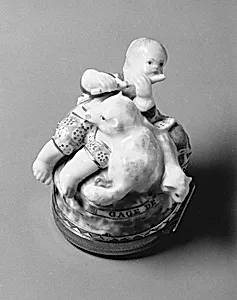
Snuffbox or patchbox
ca. 1765
Medium
Soft-paste porcelain, agate, gold
Dimensions
Height: 1 13/16 in. (4.6 cm)
Classification
Ceramics-Porcelain
Culture
British, Chelsea
Department
European Sculpture and Decorative Arts
Museum
Metropolitan Museum of Art, New York, NY
Credit
The Jack and Belle Linsky Collection, 1982
Accession Number
1982.60.354
Rights
Public Domain
Tags
Art Historical Context
This delightful snuffbox or patchbox crafted by the renowned Chelsea Porcelain Manuf around 1765, exemplifies the of 18th-century porcelain artistry. Standing just 1 13/16 inches tall, it combines soft-paste porcelain—a friable yet translucent material that mimicked prized Chinese hard-paste porcelain luxurious agate and gold accents Chelsea, active from the 0s to 1769, was a in this British innovation, producing whimsical decorative objects for affluent collectors during the Rococo era's love of playful elegance. The box likely features charming motifs of bears, children, and flutes, evoking pastoral fantasies and lighthearted vignettes popular in the period. These intricate hand-painted and molded details highlight the manufactory's mastery of colorful enameling and gilding, techniques that brought porcelain to life with vibrant realism. As a snuffbox for powdered tobacco or a patchbox for beauty adornments, it reflects the refined tastes of Georgian high society, where such trifles doubled as status symbols. Housed in The Metropolitan Museum of Art's European Sculpture and Decorative Arts collection through the Jack and Belle Linsky gift, this petite treasure offers a window into Chelsea's golden age, blending technical virtuosity with cultural whimsy. Visitors can't help but smile at its enduring charm.
About the Artist
Chelsea Porcelain Manufactory · 1744–1784
**Chelsea Porcelain Manufactory** The Chelsea Porcelain Manufactory, Britain's pioneering porcelain enterprise, was founded around 1743 in Chelsea, London, by two Huguenot silversmiths: Nicholas Sprimont from Liège and Charles Gouyn. Sprimont, trained in Paris as a goldsmith before immigrating to England, brought his expertise in luxury metalwork to the venture, while Gouyn handled early sales th...