
Soba cup
Unknown Artist
late 17th–early 18th century
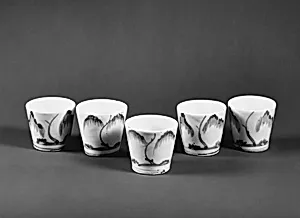
Medium
Porcelain with underglaze blue (Arita ware)
Dimensions
H. 2 1/2 in. (6.4 cm); Diam. 2 3/4 in. (7 cm)
Classification
Ceramics
Culture & Period
Japan · Edo period (1615–1868)
Department
Asian Art
Museum
Metropolitan Museum of Art, New York, NY
Credit
The Harry G. C. Packard Collection of Asian Art, Gift of Harry G. C. Packard, and Purchase, Fletcher, Rogers, Harris Brisbane Dick, and Louis V. Bell Funds, Joseph Pulitzer Bequest, and The Annenberg Fund Inc. Gift, 1975
Accession Number
1975.268.691
Rights
Public Domain
Art Historical Context
This delicate soba cup, crafted in Japan's Edo period (1615–8) during the late 17 to early 18th, exemplifies the refined artistry of everyday objects in Japanese culture. Measuring just 2½ inches tall and 2¾ inches in diameter it was designed for sipping the broth of soba noodles or rinsing the mouth—a humble ritual tied to the era's burgeoning urban food culture in cities like Edo (modern Tokyo). Produced as Arita ware from the porcelain kilns of Saga Prefecture, it reflects Japan's mastery of ceramic production after the isolationist Sakoku policy limited foreign influences while fostering domestic innovation. The cup's medium—porcelain with underglaze blue—highlights Arita's pioneering techniques, where cobalt pigment is applied beneath a transparent glaze before high-temperature firing, yielding vibrant blues that endure centuries. This blue-and-white style, inspired by Chinese prototypes but distinctly Japanese in its subtle elegance, made Arita porcelain a coveted export to Europe via Dutch traders, bridging East and West. Housed in The Metropolitan Museum of Art's Asian Art Department from the esteemed Harry G. C. Packard Collection, this unassuming vessel invites us to appreciate Edo Japan's blend of functionality and beauty, where even a simple cup becomes a testament to cultural harmony and technical prowess.