
Soba cup
Unknown Artist
19th century
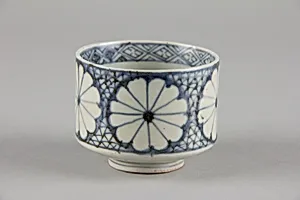
Medium
Porcelain painted with underglaze cobalt (Hizen ware)
Dimensions
H. 2 1/2 in. (6.4 cm); Diam. 3 1/8 in. (7.9 cm)
Classification
Ceramics
Culture & Period
Japan · Edo period (1615–1868)
Department
Asian Art
Museum
Metropolitan Museum of Art, New York, NY
Credit
The Harry G. C. Packard Collection of Asian Art, Gift of Harry G. C. Packard, and Purchase, Fletcher, Rogers, Harris Brisbane Dick, and Louis V. Bell Funds, Joseph Pulitzer Bequest, and The Annenberg Fund Inc. Gift, 1975
Accession Number
1975.268.653
Rights
Public Domain
Art Historical Context
This delicate soba cup, crafted in Japan's Edo period (1615–8), exemplifies the refined porcelain traditions of Hizen ware from the Arita kilns in Nagasaki province. Produced in the 19th century its petite size—standing just 2½ inches tall with a 3⅛-inch diameter—made it ideal for sipping the broth of soba noodles, a staple of everyday Japanese life. Though the artist remains unknown, such pieces highlight the anonymous mastery of Edo artisans, who elevated utilitarian objects into subtle works of art during an era of peace and cultural flourishing. The cup's medium, porcelain painted with underglaze cobalt, is a hallmark of Hizen innovation. Cobalt oxide, applied beneath a transparent glaze and fired at high temperatures, yields the enduring, vibrant blues prized in Japanese ceramics. This technique, adapted from Chinese prototypes, allowed Hizen potters to create intricate designs resistant to wear, bridging domestic use and export luxury to Europe via Dutch traders. Housed in the Metropolitan Museum of Art's Asian Art collection, this cup from The Harry G. C. Packard Collection invites visitors to appreciate Japan's ceramic legacy—where simplicity meets technical brilliance, reflecting the Edo aesthetic of wabi-sabi: beauty in modest, imperfect forms.