
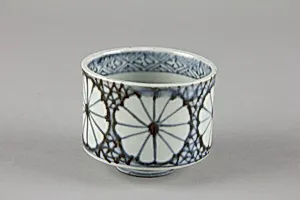
Soba cup
Unknown Artist
19th century
Medium
Porcelain painted with underglaze cobalt (Hizen ware)
Dimensions
H. 2 1/2 in. (6.4 cm); Diam. 3 1/8 in. (7.9 cm)
Classification
Ceramics
Culture & Period
Japan · Edo period (1615–1868)
Department
Asian Art
Museum
Metropolitan Museum of Art, New York, NY
Credit
The Harry G. C. Packard Collection of Asian Art, Gift of Harry G. C. Packard, and Purchase, Fletcher, Rogers, Harris Brisbane Dick, and Louis V. Bell Funds, Joseph Pulitzer Bequest, and The Annenberg Fund Inc. Gift, 1975
Accession Number
1975.268.656
Rights
Public Domain
Art Historical Context
This delicate soba cup, crafted in Japan's Hizen ware tradition during the 19th Edo period (1615–1868), exemplifies the refined porcelain production of the time. Measuring just 2½ inches tall and 3⅛ inches in diameter, its petite size was perfectly suited for serving sob—buckwheat noodles—in teahouses or homes, where diners would sip the flavorful broth directly from the vessel. Hizen ware, originating from kilns in present-day Saga Prefecture, flourished in the Edo era, a time of relative peace that spurred artistic innovation and everyday luxury goods. The cup's medium—porcelain painted with underglaze cobalt—highlights masterful Japanese ceramic techniques. Cobalt pigment, applied beneath a transparent glaze before high-temperature firing, yields the vibrant blue designs that resist fading and add a luminous depth. This method, inspired by Chinese imports but perfected locally in Hizen (notably at Arita kilns), marked a pinnacle of Edo porcelain, blending functionality with subtle elegance for domestic use rather than export. As part of the Metropolitan Museum of Art's Asian Art collection, gifted through the Harry G. C. Packard Collection, this unadorned yet sophisticated piece offers a glimpse into Edo Japan's cultured daily life, where even humble noodle cups embodied artisanal pride.