
Soldiers Attacking Robbers
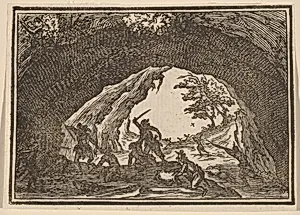
Medium
woodcut on laid paper
Dimensions
sheet (trimmed to block): 6 × 8.3 cm (2 3/8 × 3 1/4 in.)
Classification
Department
CG-E
Museum
National Gallery of Art, Washington, D.C.
Credit
R.L. Baumfeld Collection
Accession Number
1969.15.202
Rights
Public Domain
Art Historical Context
Behold *Soldiers Attacking Rob*, a dynamic 1621 woodcut on laid paper by Edouardman, faithfully reproducing an original design by the renowned French printmaker Jacques Callot. Measuring just 6 × 8.3 cm, this intimate print captures a chaotic skirmish between armed soldiers and desperate robbers, rendered in Callot's signature style of intricate, bustling compositions. Part of the National Gallery of Art's R. Baumfeld Collection ( CG-E), it exemplifies the era's fascination with dramatic, narrative scenes. Callot, a Baroque master active in the Duchy of Lorraine amid the brewing Thirty Years' War, was celebrated for his small-scale etchings depicting soldiers, beggars, and outlaws—reflecting the social upheavals of early 17th-century Europe. Eckman's woodcut adaptation translates Callot's fine lines into relief printing, where the image is carved from a wood block and printed on textured laid paper, a technique prized for its affordability and reproducibility in books and broadsheets. This process highlights the technical prowess needed to achieve such crisp details in a tiny format. The print's cultural resonance lies in its vivid portrayal of lawlessness and military might, offering a window into the turbulent world of mercenaries and highwaymen. Visitors will appreciate how Callot's influence endures, blending artistry with historical grit in this pocket-sized masterpiece.
About the Artist
Edouard Eckman after Jacques Callot
Edouard Eckman, a Flemish printmaker born around 1600, remains a somewhat enigmatic figure in art history, with his early life not well documented. Little is known about his training or formal education, though his oeuvre suggests familiarity with the vibrant printmaking traditions of the early Baroque period in Northern Europe. Active primarily in the second decade of the seventeenth century, Eck...