
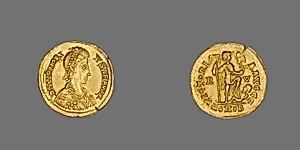
Solidus (Coin) of Honorius
405
Medium
Gold
Dimensions
Diam.: 2.1 cm (7/8 in.)
Classification
coin
Department
Arts of Greece, Rome, and Byzantium
Museum
Art Institute of Chicago
Accession Number
96054
Rights
Public Domain
About this artwork
Certainly the best-known face in antiquity was that of Alexander the Great (reigned 336-323 BCE), whose profile graced coins for two hundred years. He collected the treasure of conquered kingdoms as he swept across the Near East, and with this rich booty he set up mints that produced coins bearing his portrait. Such self-advertising was new to Greece. It had been only forty years since a portrait of a living person first appeared on coinage. The purpose of the first portrait coins was to ident...
Art Historical Context
This exquisite gold solidus, minted in 405 during the reign of Emperor Honorius, offers a tangible link to the late Roman and early Byzantine world. As the standard gold currency of the empire, the solidus served not only as a medium of exchange but also as a powerful symbol of imperial authority and economic stability. Its compact size—just over two centimeters in diameter—highlights the remarkable skill of ancient mint workers, who struck intricate designs into precious metal to ensure the coin’s authenticity and prestige. Belonging to the Arts of Greece, Rome, and Byzantium, this piece reflects the transitional era when Roman traditions blended with emerging Byzantine aesthetics. Gold coins like this one were often distributed to the military or used in diplomatic gifts, underscoring their role in maintaining loyalty and projecting power across vast territories. Visitors can appreciate how such an object combined practical function with artistic expression, preserving the emperor’s image for centuries.
About the Artist
Byzantine
"Byzantine" is the collective attribution given to anonymous artists working within the Eastern Roman (Byzantine) Empire, whose creations spanned from the 4th to the 15th centuries, primarily in Constantinople and its cultural sphere. These masters produced a vast body of art that defined an era, with museums like the Walters Art Museum and the Art Institute of Chicago cataloging numerous works un...