
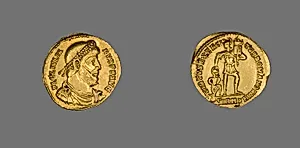
Solidus (Coin) Portraying Emperor Julian II
361 (Summer)-363 (26 June)
Medium
Gold
Dimensions
Diam.: 2.2 cm (7/8 in.)
Classification
coin
Department
Arts of Greece, Rome, and Byzantium
Museum
Art Institute of Chicago
Accession Number
5717
Rights
Public Domain
About this artwork
The front (obverse) of this coin portrays emperor Julian II. On the back (reverse), Julian is portrayed marching right, dragging a captive by the hair and holding a trophy.
Art Historical Context
This exquisite gold solidus, struck during the brief reign of Emperor Julian IIr. 361–363 CE), offers a glimpse into the late Roman Empire's world of imperial propaganda and economic stability. Measuring just 2.2 cm in diameter, this coin from the Art Institute of Chicago's Arts of Greece Rome, and Byzantium captures Julian's profile in high relief, a hallmark of Roman numismatic art. Minted in the summer of 361 until his death on June , 363, it exemplifies the solidus—a pure gold coin introduced by Constantine I around 312 CE—that served as a reliable currency across the empire, symbolizing Rome's enduring wealth and power. Julian II, often called "the Apostate" for his efforts to revive classical paganism amid Christianity's rise, is depicted with idealized features: a laurel-wreathed head turned in three-quarter view, evoking the gravitas of earlier emperors like Augustus. The reverse likely features a standing figure such as Victory or Roma, common motifs reinforcing imperial victory and divine favor. Roman minting techniques, involving dies hammered onto heated gold blanks, ensured fine details and uniformity, making coins both portable art and political statements. As a cultural artifact, this solidus bridges the classical Roman world and emerging Byzantium, highlighting how emperors used coinage to broadcast legitimacy and ideology to soldiers, merchants, and citizens alike. A tiny treasure that circulated widely, it reminds us of art's role in everyday empire-building.
About the Artist
Ancient Roman
The artists attributed to "Ancient Roman" in museum collections represent the anonymous craftsmen who produced the vast output of sculpture, frescoes, mosaics, and reliefs defining Roman visual culture from the Republic (c. 509–27 BCE) to the late Empire (c. 395 CE). Individual identities remain elusive, as Roman makers were typically viewed as skilled tradesmen—often enslaved Greeks or provincial...