
Medium
Classification
Department
Smithsonian Collection
Museum
Smithsonian American Art Museum
Credit
National Portrait Gallery, Smithsonian Institution; gift of Mr. and Mrs. Paul Mellon
Accession Number
S/NPG.74.39.2.23
Rights
Public Domain
Tags
Art Historical Context
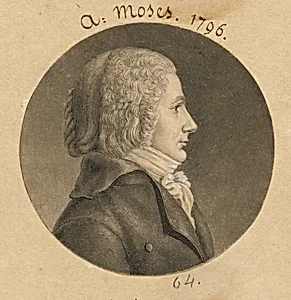
In 1796, French-born artist Charles Balthazar Févret de Saintémin captured the profile of Solomon Moses, a Philadelphia merchant, in this striking print from the Smithsonian American Art Museum Saint-Mémin, who fled the French Revolution and settled in America around 1793, revolutionizedure with his innovative "physionotrace" technique—a pantograph device that traced precise silhouettes from life, which were then engraved and hand-colored for distribution. This method made high-quality portraits affordable to the emerging American middle class, blending European precision with democratic accessibility. As a portrait of Moses, depicted in classic profile against a simple background, the work exemplifies Saint-Mémin's neoclassical style, emphasizing dignity and character over embellishment. Produced during the early U.S. Republic, it reflects the era's entrepreneurial spirit, with Moses embodying the Jewish immigrant success story in post-Revolutionary commerce. Gifted to the National Portrait Gallery by Mr. and Mrs. Paul Mellon, this print offers a window into 18th-century American identity, highlighting how art democratized fame for merchants and professionals alike.